Multiple Timeframe Analysis – mind blowing knowledge that will change everything!

Multiple Timeframe Analysis – mind blowing knowledge that will change everything!

In this article i’m going to talk about something which is paramount to your trading – multiple timeframe analysis. This will blow your mind and change the way you trade forever! Multiple timeframe analysis is essential for new traders to learn – it will change the way you trade and see the markets, forever! Let’s get straight into it…

What is multiple timeframe analysis?

Multiple timeframe analysis is what it says on the tin – undertaking analysis on multiple timeframes to get a clearer idea of what’s happening in the markets. So how does this work, and how can it help you in your trading? The basic premise is that you use ‘larger/higher’ timeframes to get a bird’s eye view of the market – where the price is going long term, what the long term trend is, if there is one. Is it in a range long term? Then you can use the smaller timeframes to ‘zoom in’ and plan and execute your trades with greater precision. Let’s take a look at how this might work. It is common for people to use the ‘daily’ timeframe as their higher timeframe. I personally use this timeframe as a higher timeframe, but note that I also refer to the ‘monthly’ timeframe as another level up, to get an even higher ‘birds eye view’ as compared to the daily.

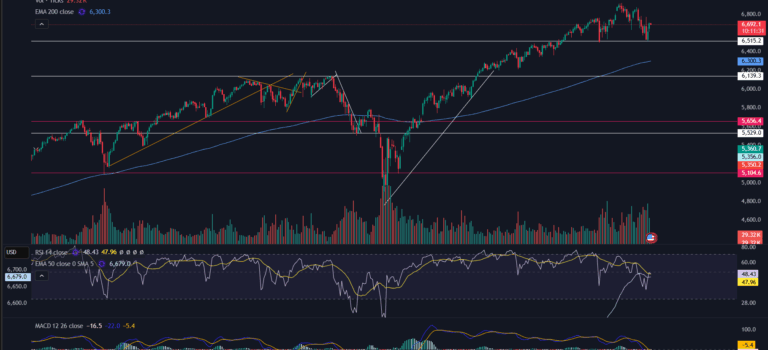
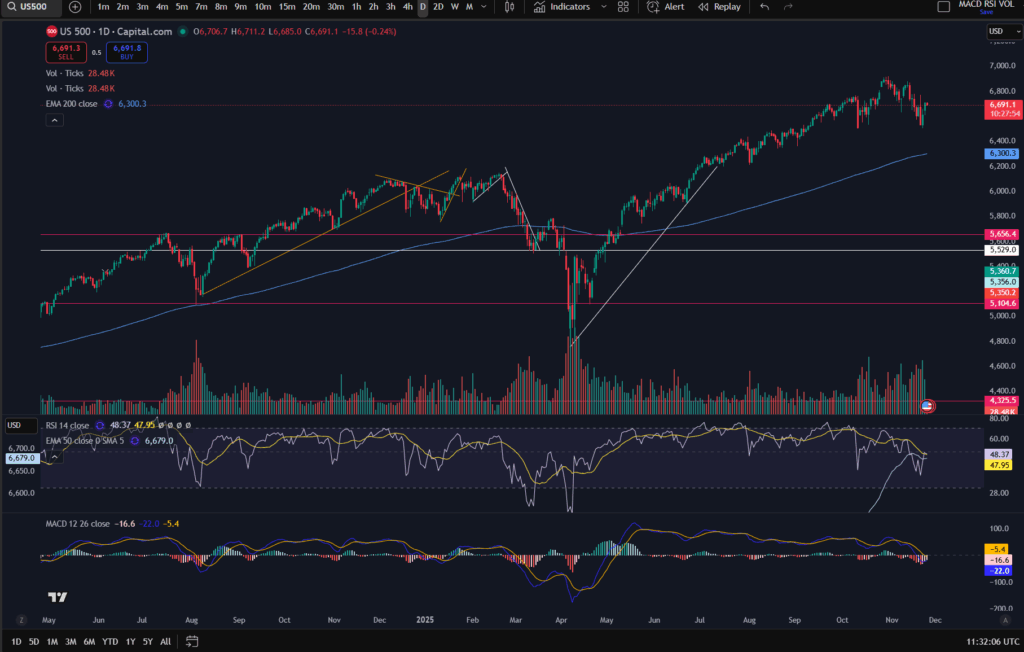
Let’s look at the daily timeframe on the S&P 500 most recently:
multiple timeframe analysis

You can use the daily/higher timeframe, to mark major support and resistance levels, as below:
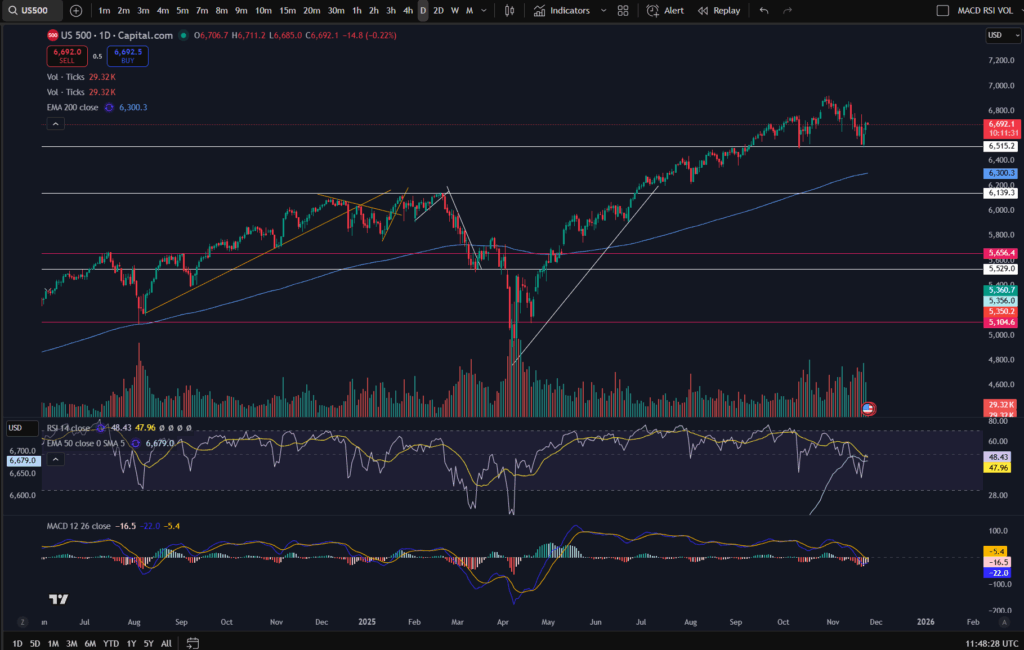
multiple timeframe analysis

You can see that the price has found a support a few times at the white marked horizontal line on the chart (6,515). (If you think you would benefit from using this chart software, I can offer you a discount, through Trading View – please click the link below):

OK, so back to the chart analysis! Why is marking the higher timeframe in this way, important when using multiple timeframe analysis? The higher the timeframe, the more people, hedge funds, big money etc, are noticing the resistance or support level – which gives it more weight! More people are going to be respecting those levels and being mindful of them. More people will get into the market at the higher timeframe support area – meaning there will be a stronger push up from that level as a result of sheer volume and demand.

So you can use the higher timeframe to plan the general ‘area of interest’ in your trade set up. For information on how to plan trades and where to get started, please see our blog article:

How to create a Trading Plan – make big wins trading – Trader Pro

Once you have got your general ‘area of interest’ per your bird’s eye view, you can then ‘zoom in’ by using a smaller timeframe. The smaller timeframe should be about 4 timeframes away from your bird’s eye view timeframe. For example, I use the daily timeframe as my bird’s eye view, and the 30 minute timeframe to execute trades, currently. I have combined the daily with the 10 minute and this did work for me, as well.

Smaller timeframe analysis – Zooming in!

OK, so now that you have your general area of interest per the larger timeframe, you can use the smaller timeframe, under multiple timeframe analysis, to plan how to ‘execute your trade. We established that on the daily timeframe for the S&P 500, there was a general resistance level at around 6,515 price. Let’s say we were just at the red X marked below and we had not gone past this point – we knew that the price typically bounces at this level and we expect it to, because in the past, this area was a resistance, too – see how the price was bumping against it, in mid August on the chart below.
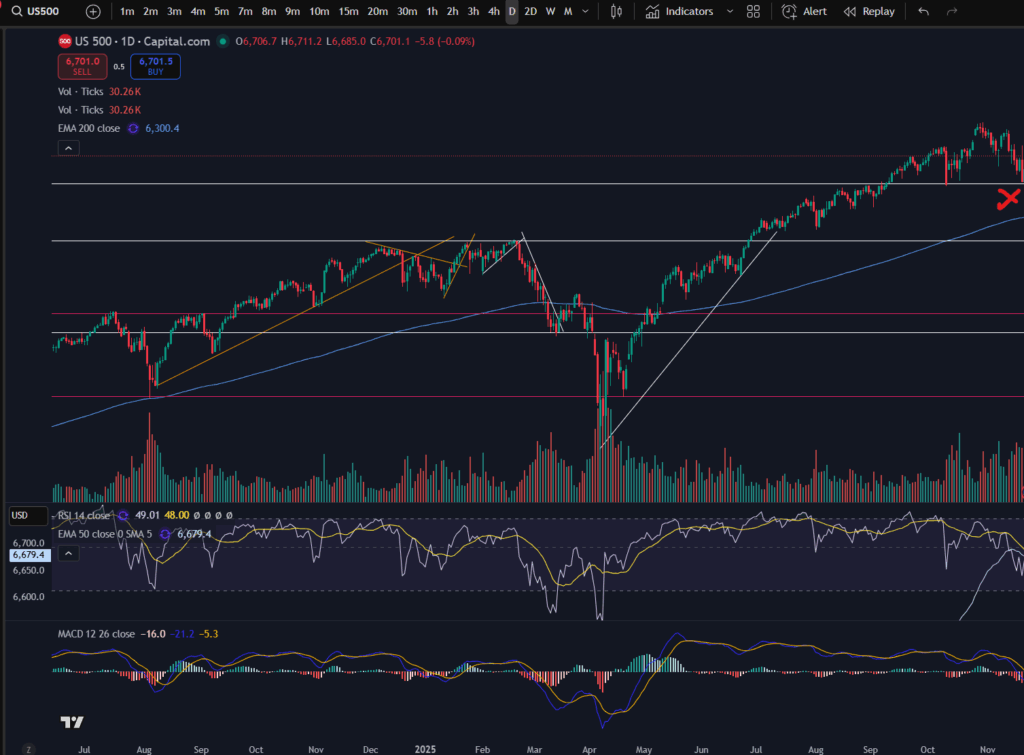
multiple timeframe analysis

Bearing in mind this is our point of interest, we might want to get into a trade here, at the support. Now let’s take a look at the 30 minute timeframe to plan this possible trade. We are interested in the price at mid November on the 30 minute timeframe. (Usually you will not have to cut off the chart in this way, obviously – i’m just showing you, retrospectively, how you may have planned and executed a trade at this level):
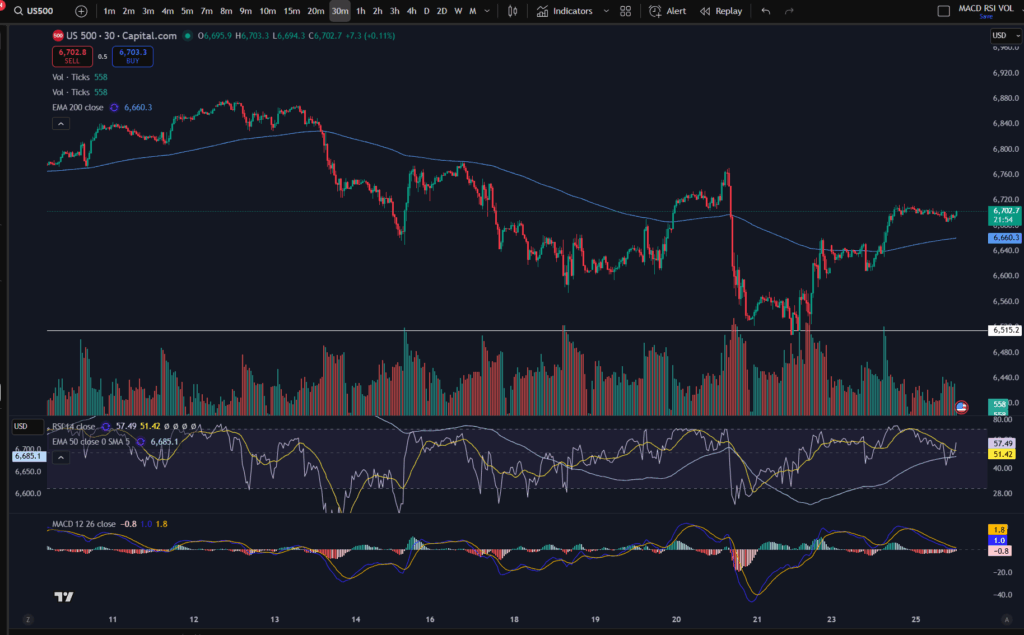
multiple timeframe analysis

OK, so here we have the zoomed in view of the ‘bounce’ on the daily timeframe. Under my strategy, I would want the price to have popped up over the EMA line before I consider entering a trade. You can see my strategy here:

NASDAQ trading strategy that will make you thousands! ££££££ – Trader Pro

The point of the lower timeframe is that you can see ‘under a microscope’, what’s happening in the market. You can execute your trade at just the right place on the chart, with extra precision.

You plan and execute your trade including the ‘take profit’ and ‘stop loss’ levels per the smaller timeframe, when using multiple timeframe analysis. Do not set a take profit on the daily timeframe. You have to understand that if you put your take profit at the top of a peak on the daily timeframe, it may take weeks to get there, depending on how many days need to go by, to get up there. This is why we plan and execute per the smaller timeframe – each candle is only 30 minutes, or 10 minutes, or whatever you choose to use. So it could take 12 x 10 minutes = 120 minutes to get to your target on the smaller timeframe of 10 minutes. If you waited for 12 candles on the daily timeframe you would be waiting for 12 days!

I hope you found this helpful. I also created a video on my Youtube Channel which you may like to see on multiple timeframe analysis:

Understand my strategy in full: https://www.patreon.com/Traderpro8320

For more great tips on trading the financial markets, please visit my blog:

https://sophiatrades.co.uk

Discount on Trading View:

https://www.tradingview.com/?aff_id=117138

My performance in the live markets:

https://sophiatrades.co.uk/category/my-performance-statistics

Finally, thank you to my existing members on Patreon, and for your likes, comments and subscribes. Happy trading!

Please note any subscriptions taken via my affiliate link with Trading View may result in me earning a small commission.

Nothing in this video should be taken to constitute financial advice. Although we make observations on the current state of the markets, nothing we suggest should be taken as an indication of what they will do next. You are required to carry out your own due diligence before entering any of the markets.
What’s happening now on the NASDAQ?

In this article i’m going to talk about what’s happening now on the NASDAQ and give you some technical analysis on the recent price movements. Let’s just get straight into it:

What’s happening now on the NASDAQ? The Monthly Time Frame

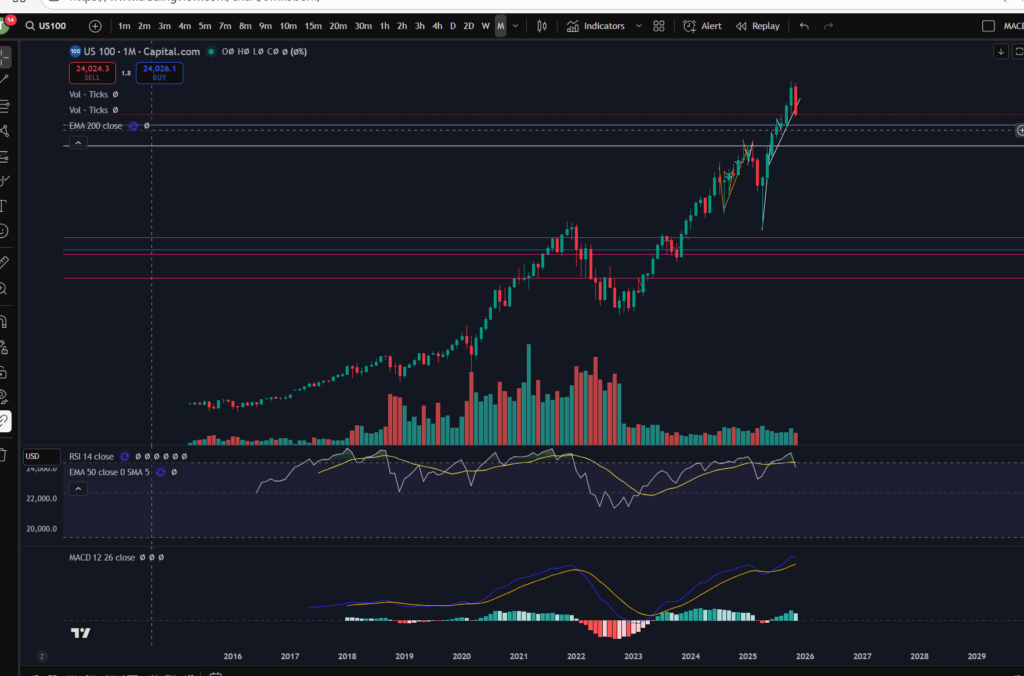
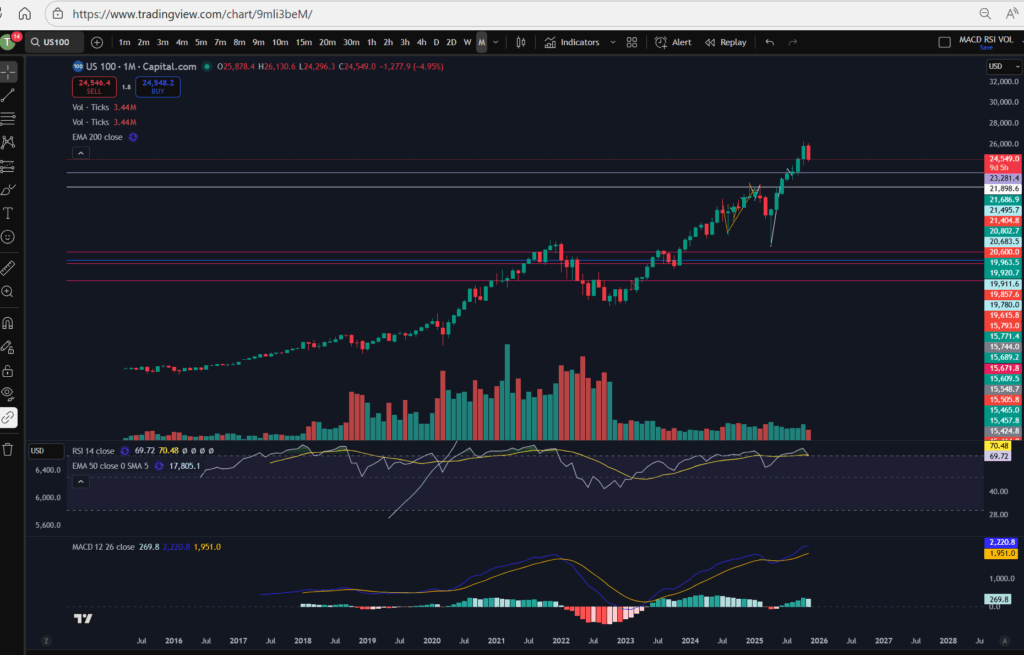
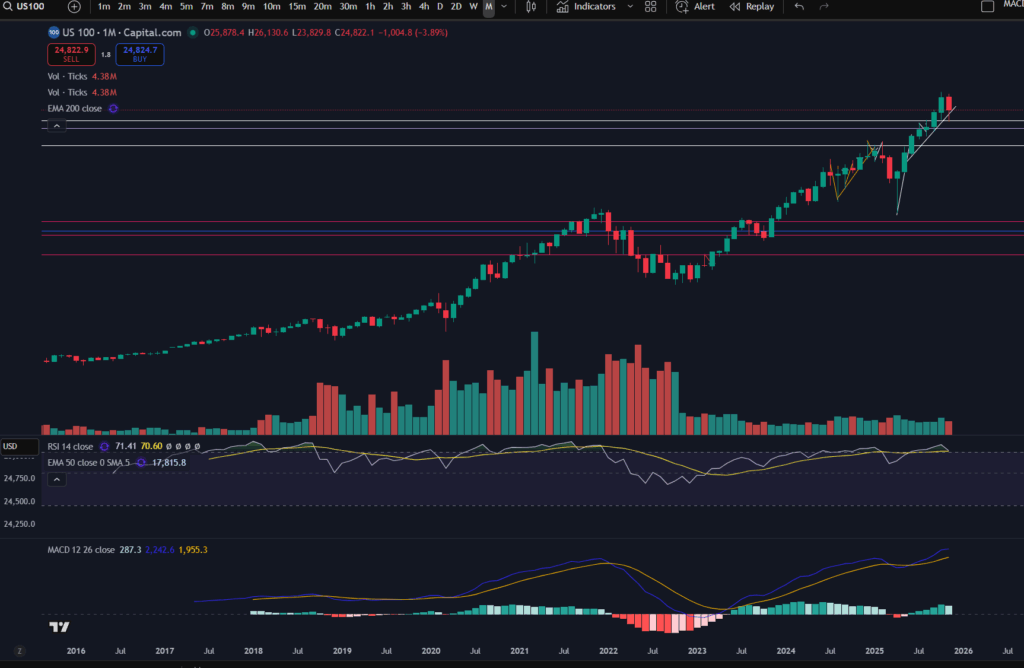
Let’s take a look at the monthly timeframe to remind ourselves of the highs the NASDAQ had reached recently:

As you can see, before this month, marked with the big red, most recent candle on the monthly timeframe, the market had pushed up considerably. The RSI was very overextended and the volume was not significant compared to the periods where significant momentum was noted (see the period between July 2018 and July 2022, for example. The market did look like it was in need of a pull back, at the very least.

Now let’s take a look at the daily timeframe.

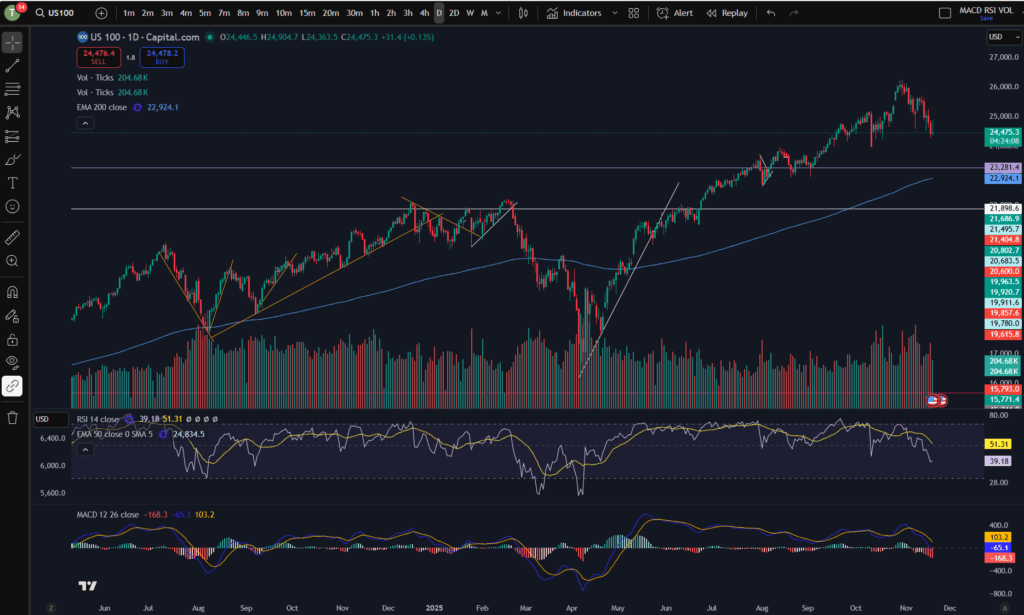
What’s happening now on the NASDAQ? – The Daily Timeframe

happening now on the NASDAQ

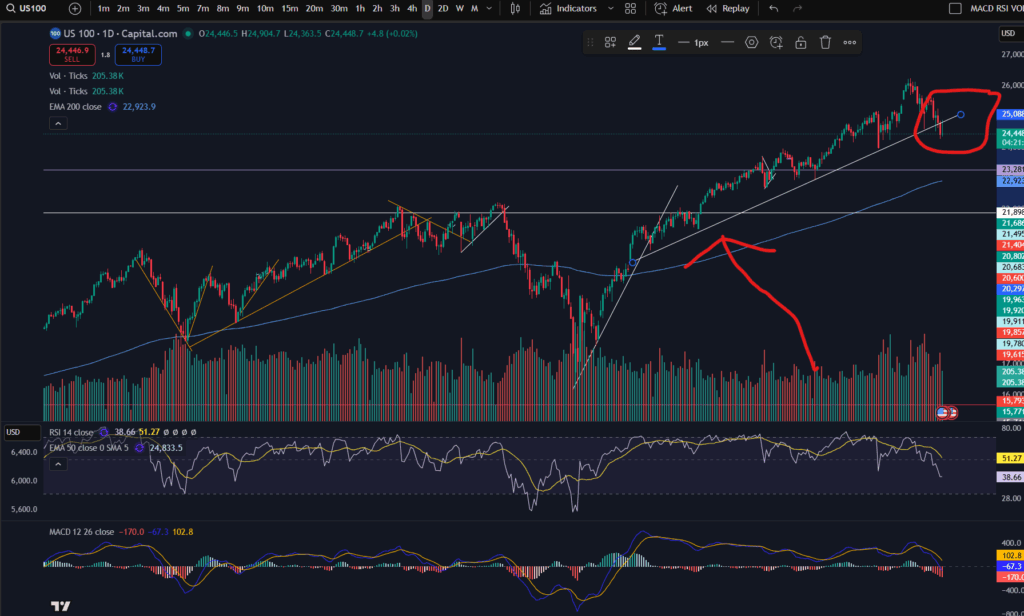
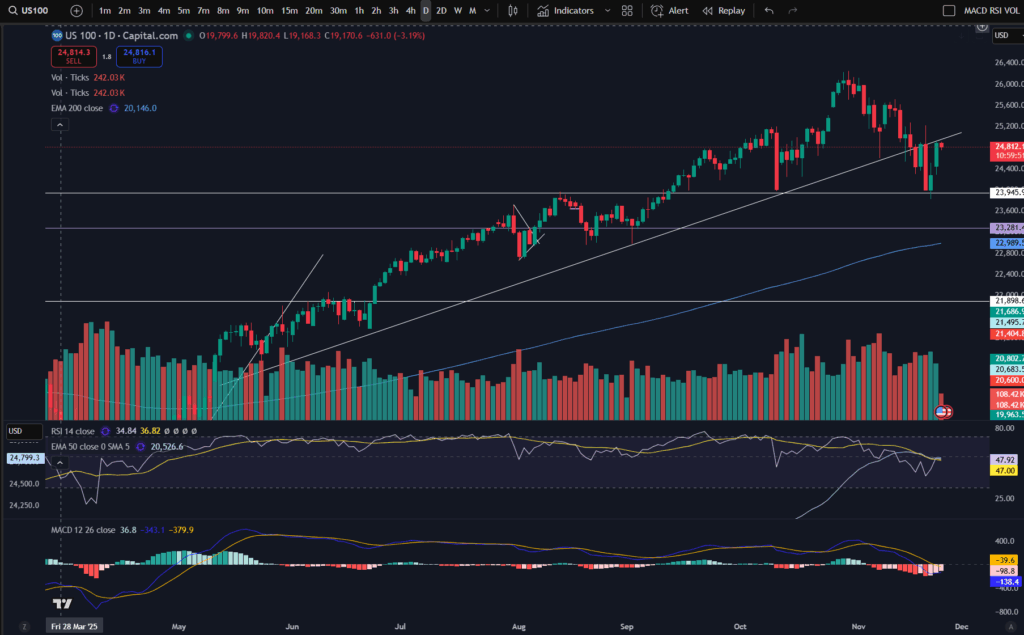
As you can see, the market was trending for a lengthy period of time, above the diagonal trend line marked on the chart. (If you would like a discount to the software I use – Trading View, please click the link below). In November the price broke this support and sailed down. It kept going until it reached the next lower level support area marked horizontally on the chart at price 23,945.

Currently the market is at a critical point – it has bounced slightly on the support level, but will it continue to sail away from this area? It’s currently touching the ‘underside’ of the diagonal support, which, as we know, can now be seen as a potential resistance.

Let’s take a look at the ‘zoomed in’ view, on the 30 minute timeframe. By the way, if you would like to understand more about ‘multiple timeframe analysis’, please see the video below:

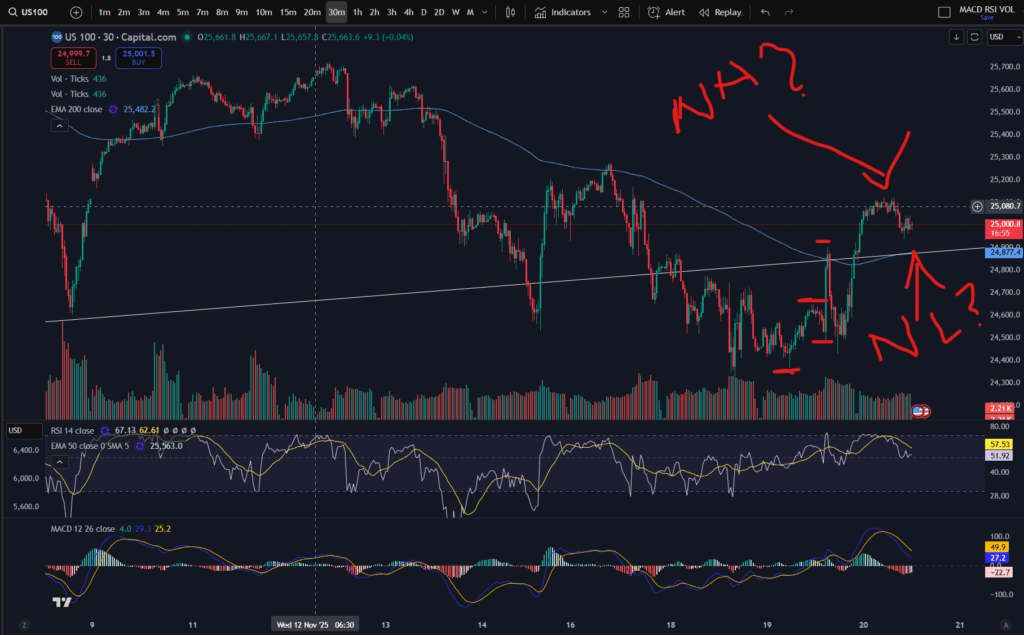
The 30 minute timeframe:

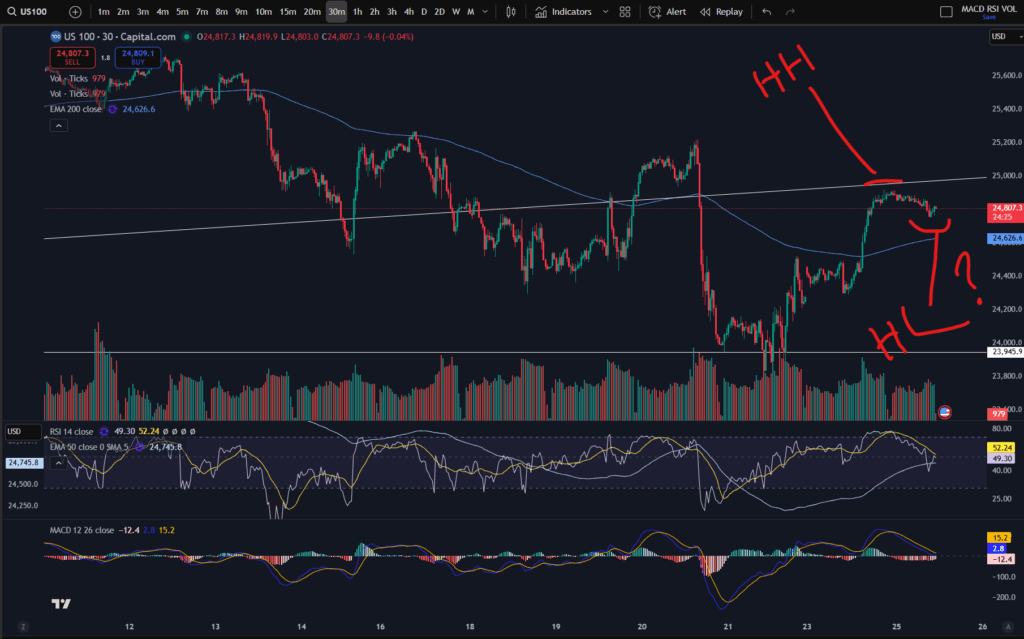
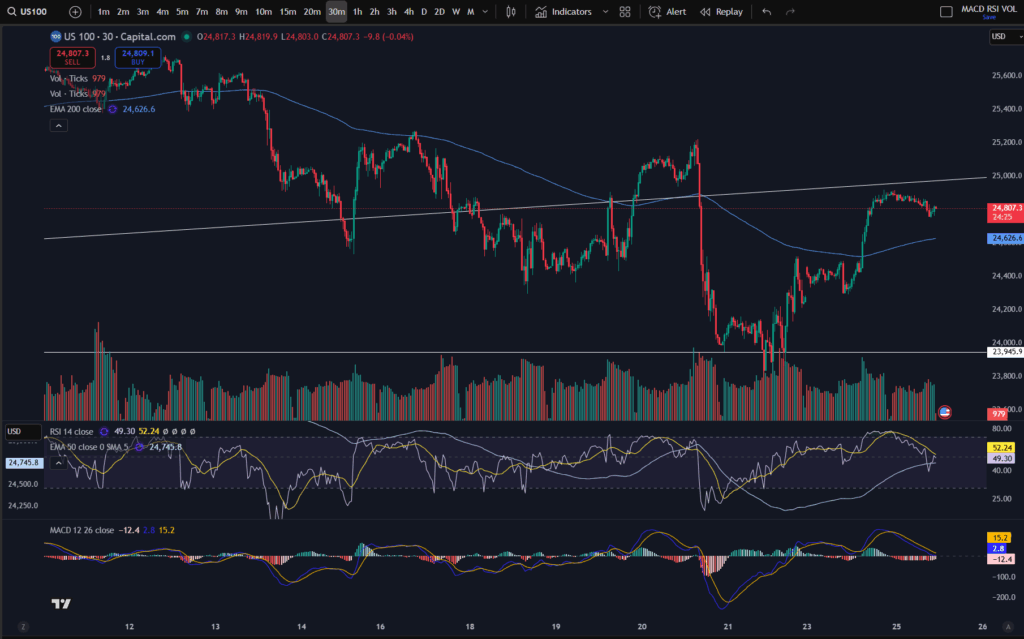
You can see more clearly on the 30 minute timeframe, that the price is currently exactly at the diagonal resistance level. It has just made a ‘higher high’ and it’s currently trying to form a ‘higher low’:

happening now on the NASDAQ

Why does this matter? The market will be considered to be trending ‘up’ once it is making higher highs and higher lows, consistently. It remains to be seen whether this will continue at the moment. As I mentioned in previous videos and posts, it could do the same thing it did previously, and pop back down, below the EMA line – you can see it did this on around the 20th – 21st November and before this, around the 13th to 14th of November.

If you would like to understand more about support and resistance levels, and how to read the markets by identifying highs and lows in a trend, please see my video here and related article:

Highs and lows video:

Blog article to help you spot whether a trend is changing direction:

Amazing secrets to help you make more money trading – spot a downtrend early! – Trader Pro

Support and resistance levels – blog article:

Support and Resistance – Trader Pro

So what’s happening on the NASDAQ then?

So ultimately, what’s happening now on the NASDAQ is that the market is trying to recover but patience is required to understand whether it will continue trying to push up. Patience is key for traders who do not short the markets.

Understand my strategy in full: https://www.patreon.com/Traderpro8320

For more great tips on trading the financial markets, please visit my blog:

https://sophiatrades.co.uk

Discount on Trading View:

https://www.tradingview.com/?aff_id=117138

My performance in the live markets:

https://sophiatrades.co.uk/category/my-performance-statistics

Finally, thank you to my existing members on Patreon, and for your likes, comments and subscribes. Happy trading!

Please note any subscriptions taken via my affiliate link with Trading View may result in me earning a small commission.

Nothing in this video should be taken to constitute financial advice. Although we make observations on the current state of the markets, nothing we suggest should be taken as an indication of what they will do next. You are required to carry out your own due diligence before entering any of the markets.
Understanding a stock chart – valuable knowledge for beginner traders

In this article i’m going to help you with understanding a stock chart, and share some tips which may help beginner traders navigate the chart’s features. This will take the beginner trader through the basic foundation of what appears on the chart, normally by default.

Understanding a stock chart – price movements

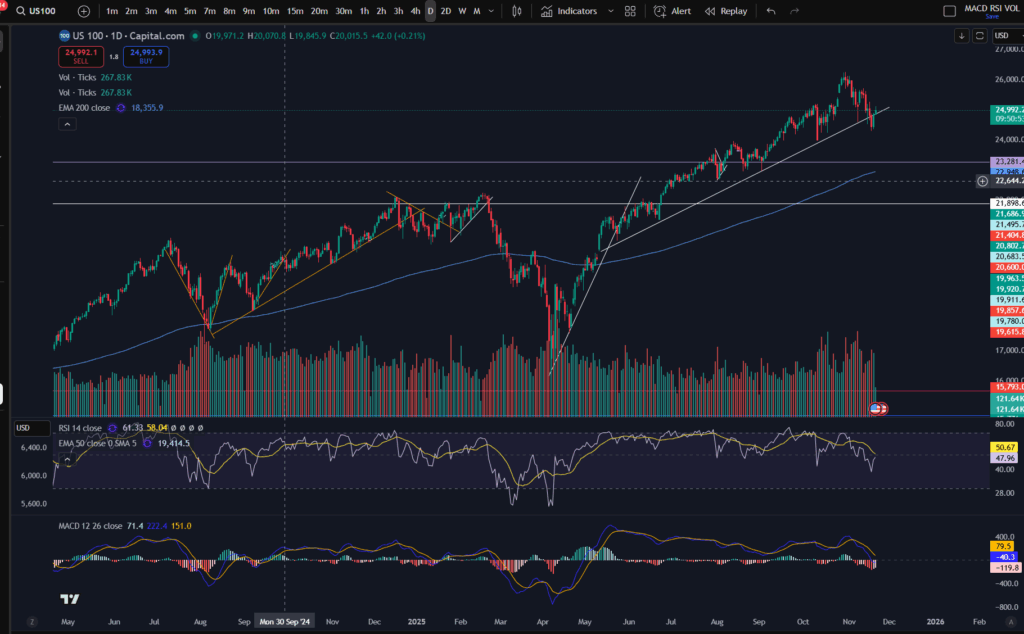
The default position you will likely find when you first look at any stock chart is that the ‘price’ movements are shown with ‘Candlesticks’. This is key to understanding a stock chart. Let’s take a look…

Understanding a stock chart

If you would like a discount to the ‘Trading View’ software which I use and highly recommend, please click the button below:

Each green or red candlestick shape you see on the chart, represents the price movement within one interval of time. The interval is determined by the ‘time interval’ buttons selected on the chart. As you can see on the above screen shot, ‘M’ is highlighted in the ribbon at the top – what this means is that this is a ‘monthly chart’ – each candlestick represents the price movements within one month’s period. I’ve posted separate articles on understanding candlesticks, which you will find here:

Make more money with Japanese Candlesticks – an Introduction – Trader Pro

The basic premise of candlesticks is that if they are green, it means the price closed higher in the interval, and if they are red, the price closed lower within the interval.

You can also understand more about the pattern formations of these, here:

Japanese Candlesticks – Trader Pro

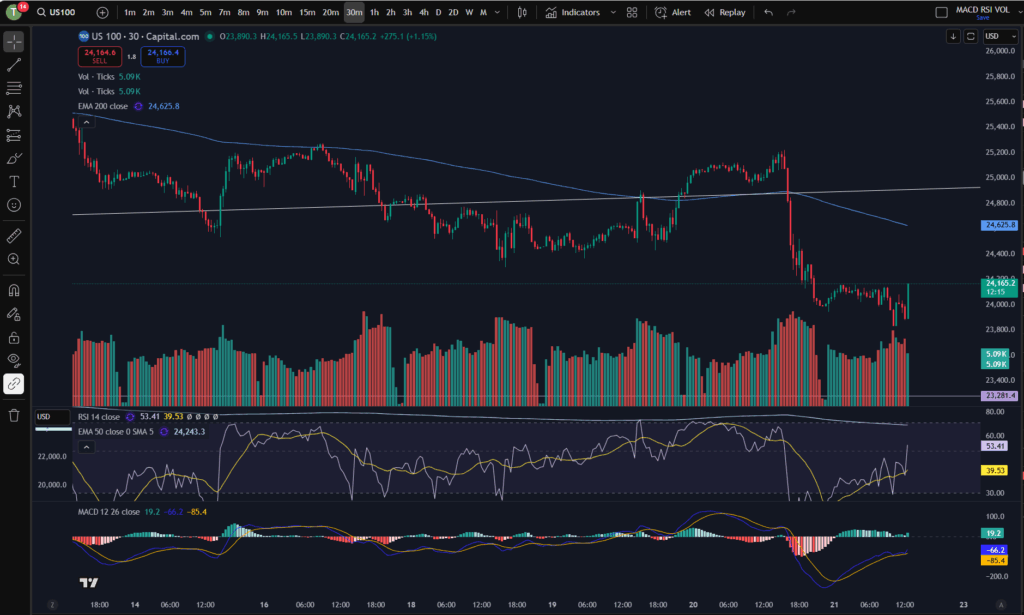
The price ‘level’ is normally displayed down the right hand side of the chart. You can see here, that the price range is 23,281 USD to 26,000 USD.

You will need to pay careful attention to which ‘price’ is being displayed… is it the price inclusive of the spread for example, or does it not include the spread? When I was a new trader, this used to catch me out – the stop loss would sometimes be triggered when the price seemingly did not go there on the chart!? It’s because the price displayed on the chart did not include the spread so the gap which was covered with the spread seemed like a mystery to me, and almost felt like broker manipulation. I understand more now.

If you check the settings in your chart carefully, you will find a setting to tell the chart to either include the spread, or not. Your wish with this, may change depending on what you are doing on the chart! If you are setting an order to ‘buy’ at a particular price, you may want to include the spread in the settings…

Understanding a stock chart – Time intervals

Each chart will have a couple of ribbons of time intervals – probably along the top and also the bottom. One of these ribbons allows you to select alternative time intervals to be displayed, as mentioned above. When these are clicked, you can toggle between for example, the ‘daily’ timeframe, and the 4 hour time frames. The daily timeframe will show you candlestick price movements, with each one representing the movement within one day, and the four hour will likewise, show you the movements for each four hours that have occurred. The other ribbon shows you the relevant tie that the price movements occurred – so you can see on the above chart, that the time spans from the year 2016 to 2029 (no candles formed yet as this is in the future at the time of writing this article).

Deal tickets

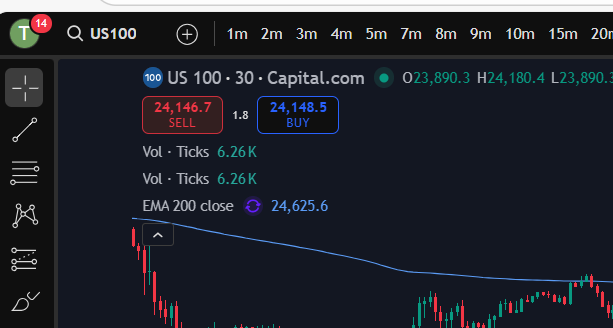
You can bring up a ‘deal ticket’ or ‘order ticket’ by clicking on the Buy or Sell buttons at the top of the screen. The value indicated on the button, is the buy or sell price and the ‘spread’ sits in between these values as below:

You do need to understand the spread, and I have linked another article below, which gives you an understanding of this:

Understanding the spread – Trader Pro

In short, the spread is the bit of price, in between the buy and sell values and it’s the ‘cut’ that the broker takes from the market.

The different types of deal tickets and orders you can place in the market, will be covered in another article.

Toolbar

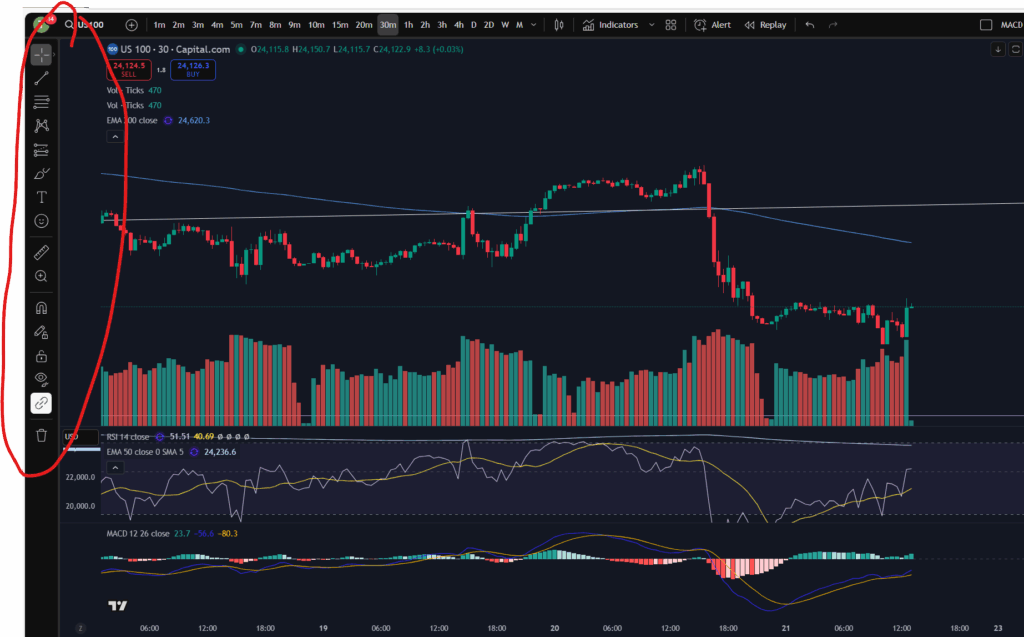
You will see somewhere on your chart, a toolbar with different symbols on it. On Trading View, this is down the left hand side of the screen:

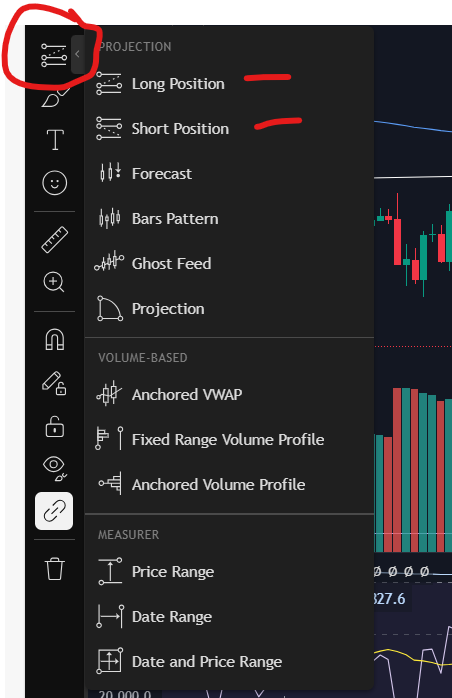
This gives you various different tools for drawing symbols and diagrams on your chart. You can draw ‘support and resistance’ lines including horizontal and diagonal ones. You can also measure price and time interval values with the ‘ruler’ shown. It’s got a zoom in/out function. You can make notes and keep them pinned to the chart indefinitely.

You can also plan trade set ups in terms of where you will enter, take profit or take a loss, with this icon:

Technical indicators

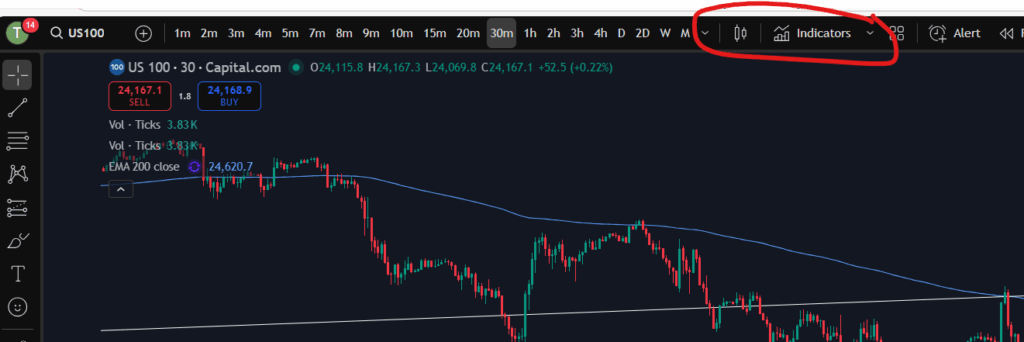
Another important aspect of understanding a stock chart which you will want to become familiar with, is the technical indicators menu. This is where you will find the MACD indicator, the volume, moving averages – any type of indicator you wish to add to your chart. There is a wide variety with Trading View which is another reason I really like the software.

For my own strategy and set up, I use the RSI, the MACD, the volume, and the 50 and 200 period EMA lines (exponential moving averages).

In Trading View, you can find the Technical Indicators menu, here:

Understand my strategy in full: https://www.patreon.com/Traderpro8320

To see my YouTube video explaining this article, please click the following link:

For more great tips on trading the financial markets, please visit my blog:

https://sophiatrades.co.uk

Discount on Trading View:

https://www.tradingview.com/?aff_id=117138

My performance in the live markets:

https://sophiatrades.co.uk/category/my-performance-statistics

Finally, thank you to my existing members on Patreon, and for your likes, comments and subscribes. Happy trading!

Please note any subscriptions taken via my affiliate link with Trading View may result in me earning a small commission.

Has the NASDAQ pull back ended? Trade now?

Has the NASDAQ pull back ended? In this article i’m going to consider the answer to this. I will talk about some signs which ‘could’ indicate that the NASDAQ may have finished pulling back. As with all my technical analysis you are strongly encouraged to do your own due diligence before placing any trades or investments in the markets. Let’s take a look at whether the NASDAQ pull back has ended.
NASDAQ pull back ended? – Recent movements

As I mentioned a day or so ago, the markets in general are in a well needed correction phase. They had pulled back quite a bit per the daily timeframe… Let’s take a look at the NASDAQ per the daily timeframe to get a reminder of where it sits currently. This will help us to decide whether the NASDAQ pull back ended…

NASDAQ pull back ended

For a discount to the chart software I use, and highly recommend, please click the link below!

As you can see above, the NASDAQ had pulled back down to just below the diagonal trend line. It seems like it could be bouncing there… Note the MACD histogram is losing it’s pigmentation and shrinking in size, and this can indicate that the move is running out of steam.

Let’s take a look at the 30 minute timeframe.

Let’s zoom in with the 30 minute timeframe!

NASDAQ pull back ended

I mentioned a day or so, ago, that the market looked like it was forming new highs and lows after the downward move and this trend seems to have continued. As you can see marked above, it seems to be forming a new high and a new low, but I would want to wait to see another MACD cross over for this high/low to be confirmed. You can see my separate blow article, on how to decide where the highs and lows are, here:

Amazing secrets to help you make more money trading – spot a downtrend early! – Trader Pro

So has the market finished its pull back?

Since the markets were very overbought recently, I would want to see continued highs and lows in this way before I decide that the market has turned around. It does look for now, like it’s trying to recover and push up. I’m conscious the US market is not currently open at the time of writing this, so I will be interested to see what happens at market open today. I am also very conscious that the markets are quite choppy currently and this scenario is a repeat of what happened previously, mid-downtrend – see the section to the left of the 30 minute timeframe chart above, where, in a similar way, the price popped up over the EMA lines and started up trending temporarily, only for it to descend further, subsequently. There is a possibility that this will happen again – I will be watching and waiting.

I hope you found this article helpful.

For more great tips on trading the financial markets, please visit my blog:

https://sophiatrades.co.uk

Discount on Trading View:

https://www.tradingview.com/?aff_id=117138

My performance in the live markets:

https://sophiatrades.co.uk/category/my-performance-statistics

Finally, thank you to my existing members on Patreon, and for your likes, comments and subscribes. Happy trading!

Please note any subscriptions taken via my affiliate link with Trading View may result in me earning a small commission.

Markets are dropping – how to beat them!

Markets are dropping and in this article we take a look at the recent activity on the NASDAQ and possible technical factors which have triggered this. We hope you find this useful.

Markets are dropping – recent NASDAQ activity

The recent activity on the NASDAQ has been extremely bullish… let’s take a look at the monthly chart:

As you can see, the NASDAQ recently reached all time highs. The RSI was very over extended, and the price had been pushing up for a sustained bull run period. It was about time they pulled back! You can see the history of the RSI indicator above. When uptrending, the RSI purple line above, pulls back and forth at the top of the RSI indicator area. Each time the RSI level reaches the highs it had stretched to before, a pull back happened. This time was no different – we were waiting for it! The pull back currently happening feels large, but in reality, it is small in comparison to the amount the markets have pushed up recently.

Markets are dropping – a view from the Daily Time Frame…

Markets are dropping

As you can see from the daily timeframe above, the pull back happening was almost necessary. The price has pulled back down further than the diagonal trend you can see on the bottom of the pattern above – please see this marked below…

You can see above, that the price as bouncing on a nice diagonal support level on the daily time frame, but within the last couple of days, the price has broken this support level.

The RSI has sunk down quite low on the daily timeframe – as you can see above, but the MACD histogram is still showing dark red bars which are growing in size (meaning the downwards move is not yet running out of steam). We could see lower prices still – it remains to be seen whether the price will start recovering or commence a return back up to where it was.

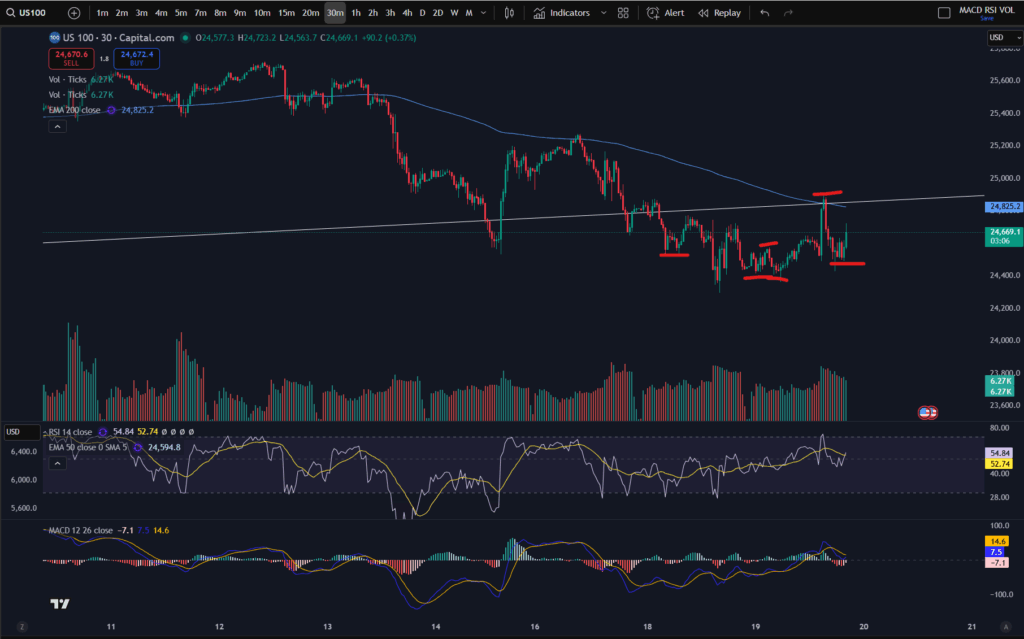
This evening I can see it has started bouncing around on the 30 minute timeframe:

A view from the 30 minute timeframe:

You can see the downtrend on this 30 minute screen shot in more detail… however, note that the price is currently trying to find support… Note the ‘steps’ I have marked on the chart in terms of the highs or lows… the first three marks counting from the left, were confirming that the 30 minute timeframe was still down trending. However, note that the fourth mark created a ‘higher low’ and the next one reached a ‘higher high’… it may be that the market has started to recover – I will be watching it carefully. My next steps will be to look out for solid signs of support and a turn around on the chart. Once I feel comfortable that the price is recovering, I will be more comfortable to place some more trades… for now, I wait….

I hope you found this article and my technical analysis helpful. If you would like to reach out with any trading questions or analysis questions, I would love to hear from you.

For more great tips and advice on trading the stock market, please visit:

https://sophiatrades.co.uk

To watch me trade live please visit my patreon page here:

https://www.patreon.com/Traderpro8320

Finally, if you would like to receive a discount on the Trading View charting software I use, please click on the relevant link here:

https://www.tradingview.com/?aff_id=117138

Please note any subscriptions taken via my affiliate link with Trading View may result in me earning a small commission.  However, I provide complete transparency on me using Trading View personally – I publish my success on the financial markets via my broker reports and any profits earned were done so by using my own Trading View subscription,  so I genuinely do recommend them and have been using the Trading View charts for many years.

Breaking down my profitable trades on Google for you

In this article I’m going to be breaking down my profitable trades on Google for you. These are in line with my MACD trading strategy which is a multi-timeframe analysis strategy, the details of which can be found linked on this blog and on my Patreon page and You Tube account. I will breakdown my entry and exists and the reasons behind these decisions. I hope you find the article useful.

What strategy to use for making profitable trades on Google?

I recently shared a strategy on my You Tube channel which outlines a flexible, profitable way of placing trades repeatedly on a market. The strategy is especially suited to trading the NASDAQ but I have been applying it to other markets with success. It can be applied to Google to make profitable trades on Google too. You can find the strategy below:

The strategy is based on my original MACD strategy which you can find on my Patreon account, linked below. However, it is now tailored to deal with the Trump tweets and trade wars as well as the other turbulence on the markets. I used to use a stop loss but I no longer control my risk in this way. You can find a video on what I changed to make my trading style more adaptable to the turbulence in the stock markets, here:
So now that I’ve explained which strategy I’m using currently, I’m going to be breaking down my profitable trades on Google for you.

Trades on Google – explained

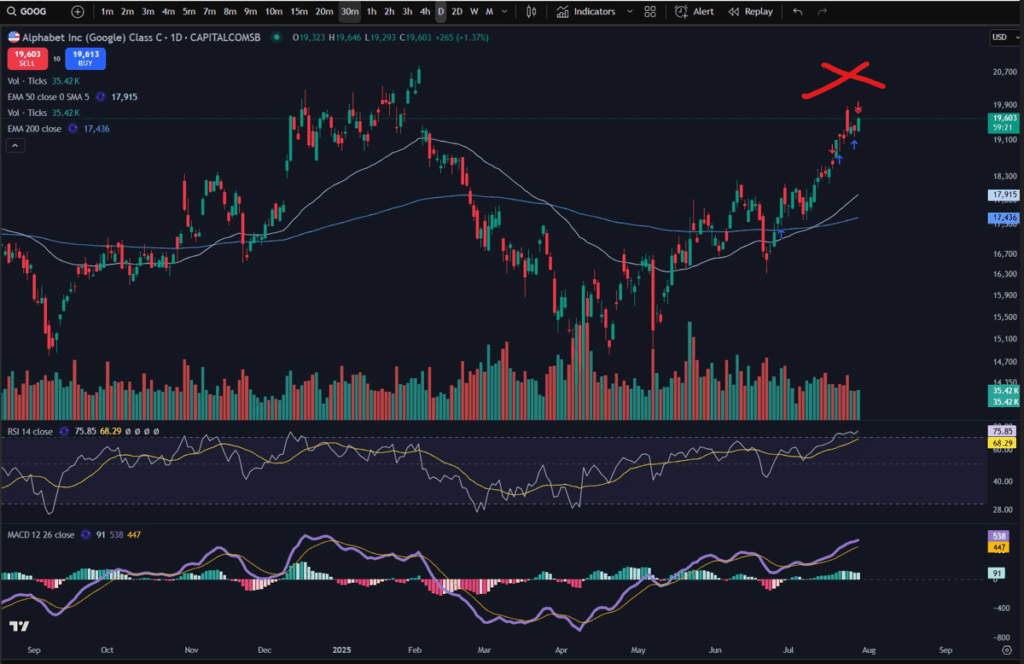
So as you will know from reviewing my strategy above, the first thing I look for is a market which is ‘uptrending’ on the daily timeframe. I make sure that there is plenty of headroom before it reaches the previous high. Let’s take a look at Google Class C’s daily timeframe chart per Trading View to analyse the profitable trades on google I placed. (To get a discount on Trading View, please see the link below):

Google Class C – Daily Time Frame:

profitable trades on Google

You can see that the previous highs reached in around February 2025 are some way off from the recent prices where I have marked the chart with a red cross. Since there is plenty of scope for the price to come up to previous levels, and the price has been in a nice uptrend since around April – May 2025, I began to look for opportunities on a smaller time frame. It is worth noting that another key item I focus on, on the daily timeframe is the position of the MACD indicator. The MACD indicator was ‘on its way up’ after the MACD and signal lines had crossed over, and the histogram bars were still green. I also look at the RSI indicator. This one was showing that the market was in fact a little overbought when I entered. However, knowing that the market had plenty of scope to come up and given my more flexible trading style outlined in the video above in terms of adapting to turbulent market conditions, I knew I had a good chance of making profit on the stock from this position. I waited for a pull back on the smaller timeframe (30 minute timeframe) – examined below.

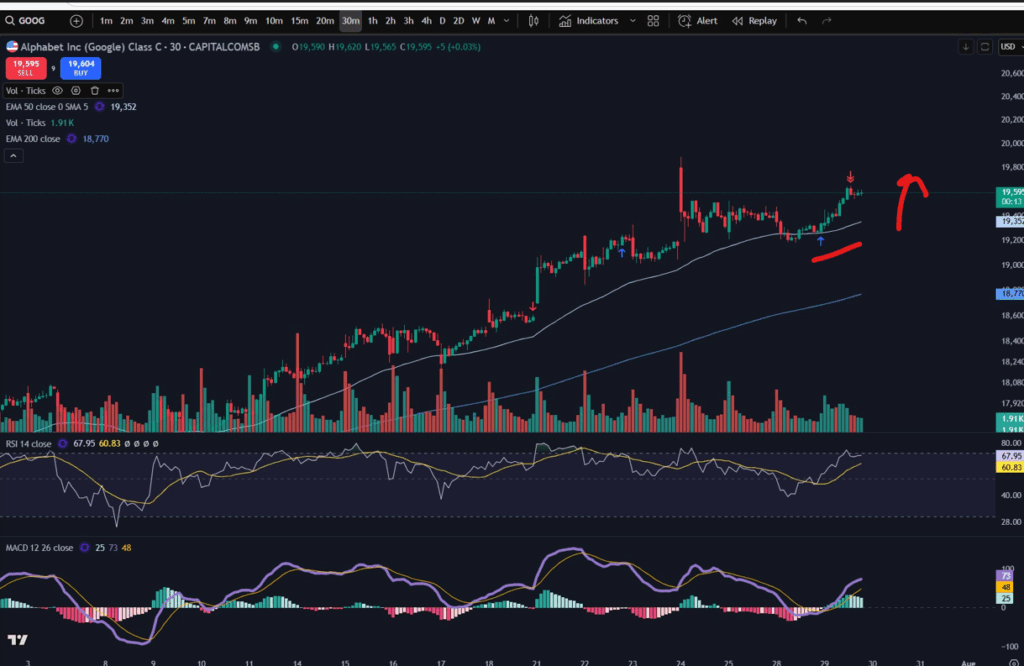
Google Class C – 30 Minute Time Frame:

As you can see in the above chart screen shot, I entered the market where the blue arrow is – a perfect entry according to my MACD strategy. The price did indeed go on towards previous highs and this is where I exited. (I actually had two positions on this market when I exited. You can see the preceding blue arrow where I entered for the first time. Unfortunately I missed my exit with that first one and got out of both trades at the red arrow. As per my video shared above, I no longer set profit targets or stop losses habitually. I do set a stop in certain conditions only – when the market has gone into profit and I want to ride a trend.

You can see on the 30 minute timeframe that the RSI was low at the point of entry, the MACD and Signal lines had just made a cross over and I knew from analysis on the daily timeframe that the market had a good chance of coming up further. The market was also making higher highs and higher lows on this 30 minute timeframe which is a crucial check I carry out before entering on the smaller timeframe.

The trade was profitable. I am finding this method of trading with a more flexible approach to risk management, much more beneficial (and less stressful).

I hope you enjoyed this article. I encourage you to carry out your own due diligence before placing any trades but I hope this analysis was of some assistance to you in terms of you understanding some possible approaches to trading.

If you appreciate these free articles it would really help me to finance them and produce more of them, if you are able to make a purchase on my Patreon page by subscribing as a member or purchasing a video – linked below.

Useful links for you:

Understand my strategy in full: https://www.patreon.com/Traderpro8320

For more great tips on trading the financial markets, please visit my blog:

https://sophiatrades.co.uk

Discount on Trading View:

https://www.tradingview.com/?aff_id=117138

My performance in the live markets:

https://sophiatrades.co.uk/category/my-performance-statistics

Finally, thank you to my existing members on Patreon, and for your likes, comments and subscribes. Happy trading!

Please note any subscriptions taken via my affiliate link with Trading View may result in me earning a small commission.

Amazing secrets to help you make more money trading – spot a downtrend early!

In this article I’m going to show you how to spot a downtrend early and identify whether or not a market is still genuinely uptrending. The first thing you look at is whether or not the price is floating above the 200 period EMA – sure, but how do you know if it’s started to downtrend, inspite of this? I share this secret below.

Spot a downtrend early – the highs and lows of the trend

The highs and lows of a trend really are the trader’s bread and butter. Without identifying these there are multiple things that can go wrong with the trading set up. New traders should really slow right down and take some time to identify these – they are critical to success. You will make a lot more money trading by spotting the highs and lows and avoiding bad entries where the market has just started to reverse to the downside.

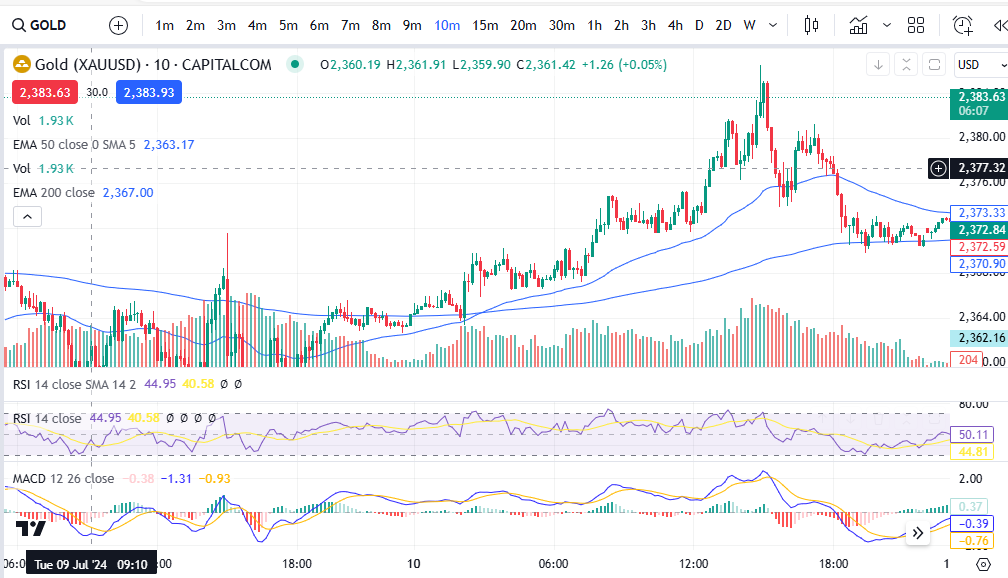
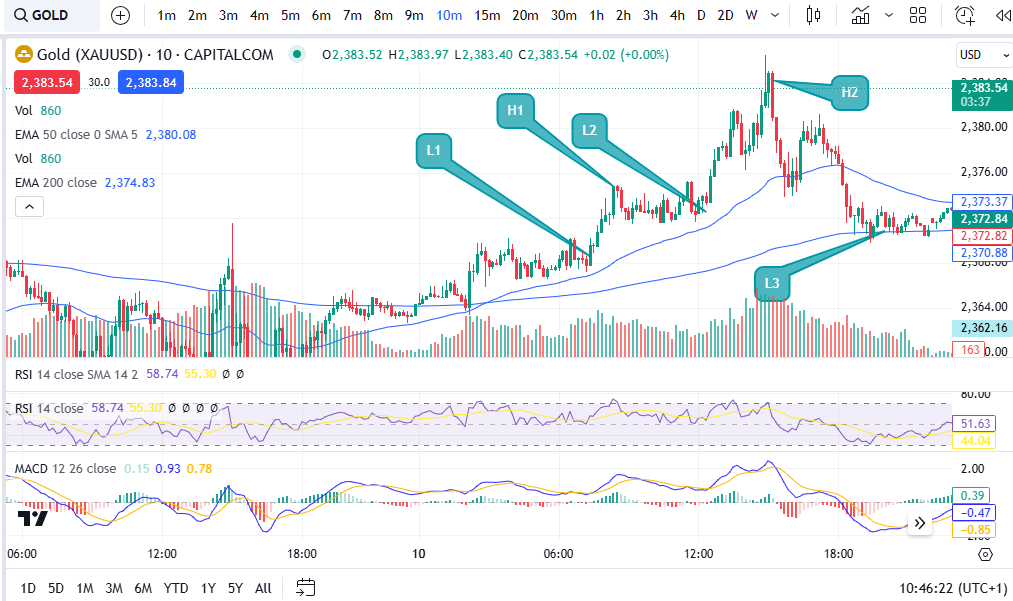
Let’s take a look at some examples. Let’s consider the market of Gold as an example, on the 10 minute timeframe… take a brief look at the chart below, and try to decide whether it’s uptrending based on recent activity, before continuing to read on…….. did you do it?

OK, let’s consider my answer to this question. It’s above the 200 period EMA – GREAT! However, let’s now look at the highs and lows. You can check exactly where the highs and lows are and use these to spot a downtrend early, on the basis of the ‘swings’ of the MACD indicator and this is one of the practical ways the MACD can really help you in your trading – aside from giving you entry signals:

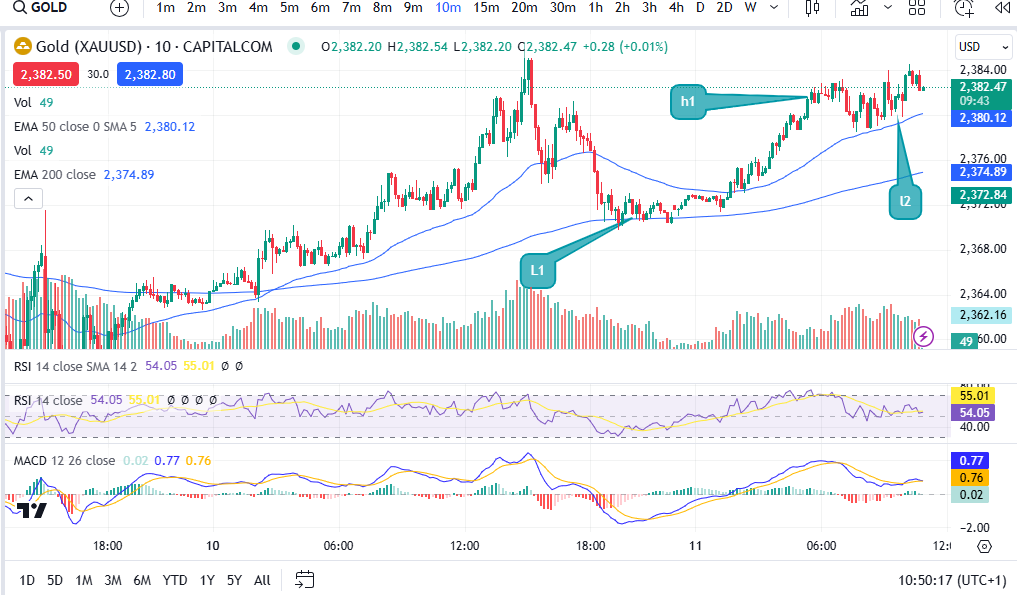
As you can see, at first glance the market does look like it’s now uptrending, but when you look closely, low 3 is now lower than low 2. In an uptrending market, the market makes ‘higher highs’ and ‘higher lows’. The pattern of uptrend has been anialated at the point of low 3. It starts again at that point – you can wait and see if it starts making higher highs and higher lows from that point onwards… a bit like this:

OK, so the pattern has started again at the original ‘low 3’ which I now refer to as low 1. As you can see it did go on to make higher lows again at low 2 in the above chart. You need the confirmation of it forming new highs and lows before placing a trade!

How this can help or hinder your strategy

Let’s consider what this could have done to your trade set up and win rate and profits/losses, if you ignored this break of pattern…

Let’s say you wanted to get in at the MACD cross over as your entry signal. (To understand more about this please see my strategy that I teach on Patreon, here:

https://www.patreon.com/collection/485557?view=expanded

You can also see my other article about how the MACD indicator works, and what it does, here:

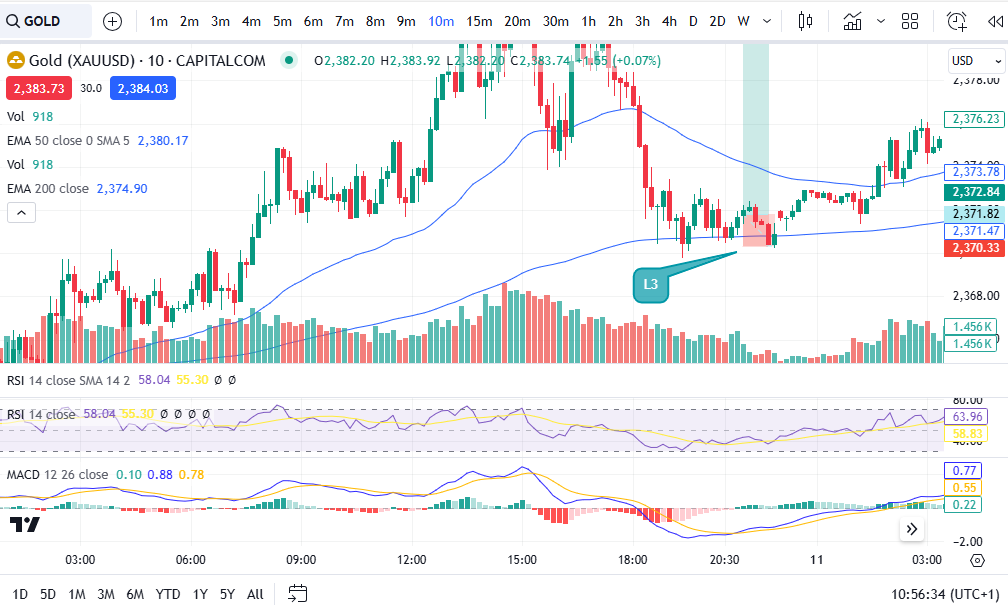
Let’s further suppose that you entered the market at the MACD cross over at the low which was previously referred to as low 3, here:

SPOT A DOWNTREND

You set your stop just below the low of the trend at the level which is shown in line with the bottom of the trade set up diagram applied (2370.33). As you can see, because the market was making lower highs, it went on to chop down into the stop loss before recovering. This loss would have been something that could have been completely avoided had the trader taken the time to spot a downtrend forming by identifying the highs and lows. Consistency in the pattern is key, before entering the market!

I have seen this help me avoid bad entries on many, many occasions. It does mean that you end up ‘avoiding’ placing trades and you place fewer trades, but with trading, less is more!! You will make more money trading, by placing fewer trades.

I hope you found this article helpful.

For more great tips and advice on trading the stock market, please visit:

https://sophiatrades.co.uk

To watch me trade live please visit my patreon page here:

https://www.patreon.com/Traderpro8320

Finally, if you would like to receive a discount on the Trading View charting software I use, please click on the relevant link here:

https://www.tradingview.com/?aff_id=117138

Please note any subscriptions taken via my affiliate link with Trading View may result in me earning a small commission.  However, I provide complete transparency on me using Trading View personally – I publish my success on the financial markets via my broker reports and any profits earned were done so by using my own Trading View subscription,  so I genuinely do recommend them and have been using the Trading View charts for many years.

Make money trading – some recent profitable trades for you!

Hi guys

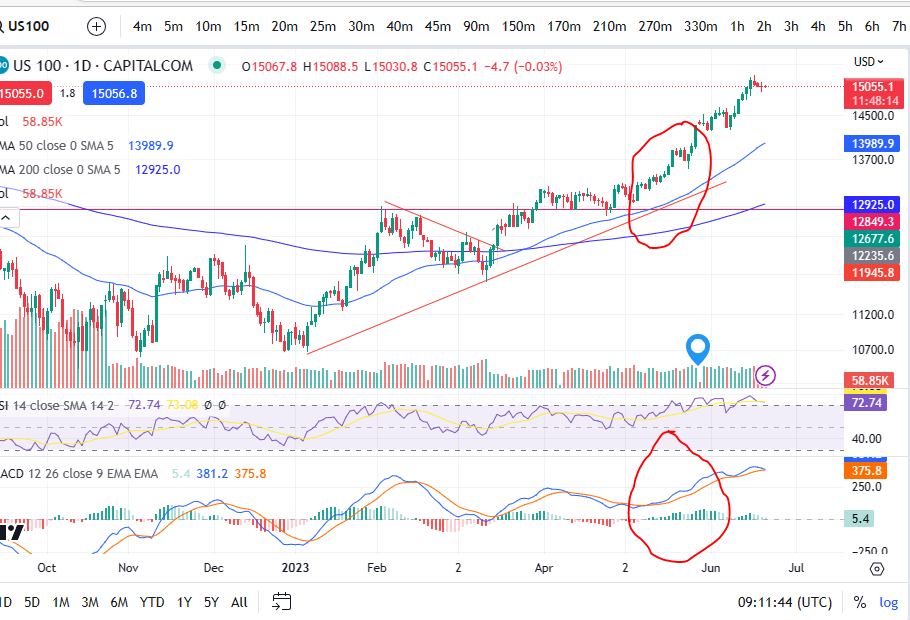
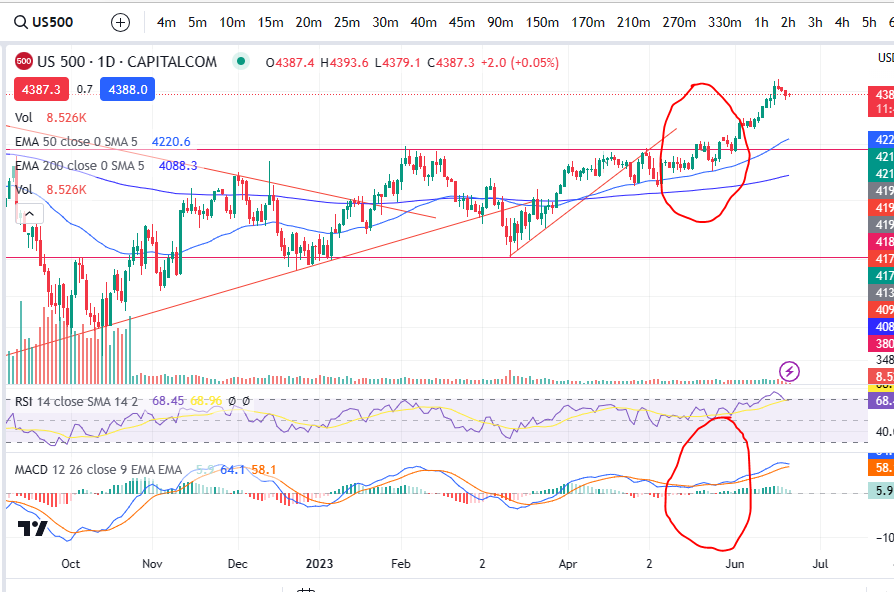
Just wanted to share some recent profitable trades I placed in May… May was a very good month for me. I’m sorry this is a bit late! The first thing to note is the direction of the overall market in May… See below screen shot of the NASDAQ and the S&P 500 on the daily timeframes. They were both in a nice uptrend with the MACD opening up:

Markets overall – recent profitable trades

I like to get into trades when the markets overall are about to make a MACD cross over or that has just happened. The S&P 500 was a bit slower than the Nasdaq – you can see the cross over was a bit bumpy and happened mid month!

Now lets take a look at some trades I placed:

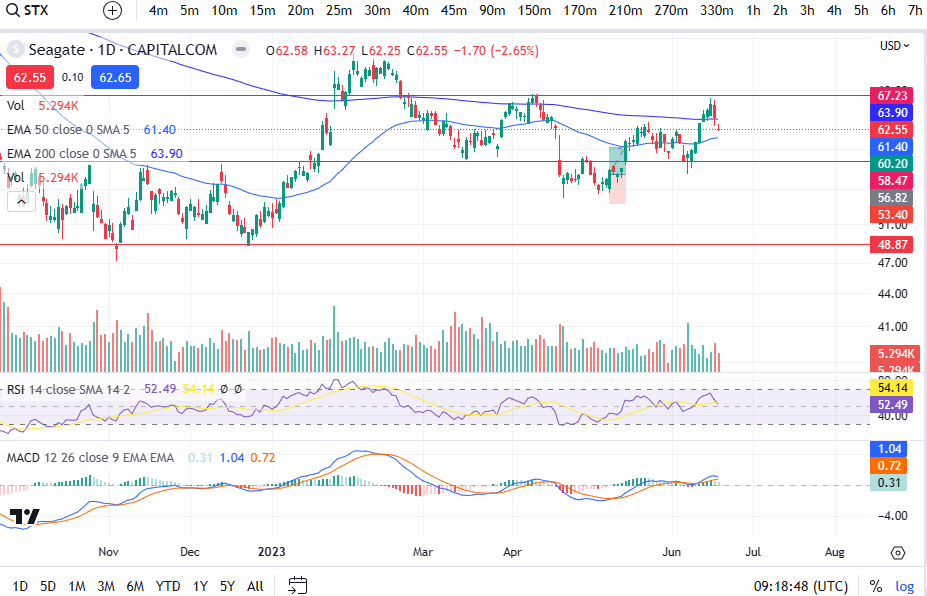
Seagate – recent profitable trades

This is an IT company. The trade I placed on this one was not for beginners – it’s not in a nice strong uptrend currently. However, I knew the price was in a habit of bumping against the EMA line at at the point I entered on 9th May, it had reached another low, and we had just had a MACD cross over. I set my target for the EMA line as I knew there would be some resistance there. Sure enough it reached it’s target by 15th May and was profitable.

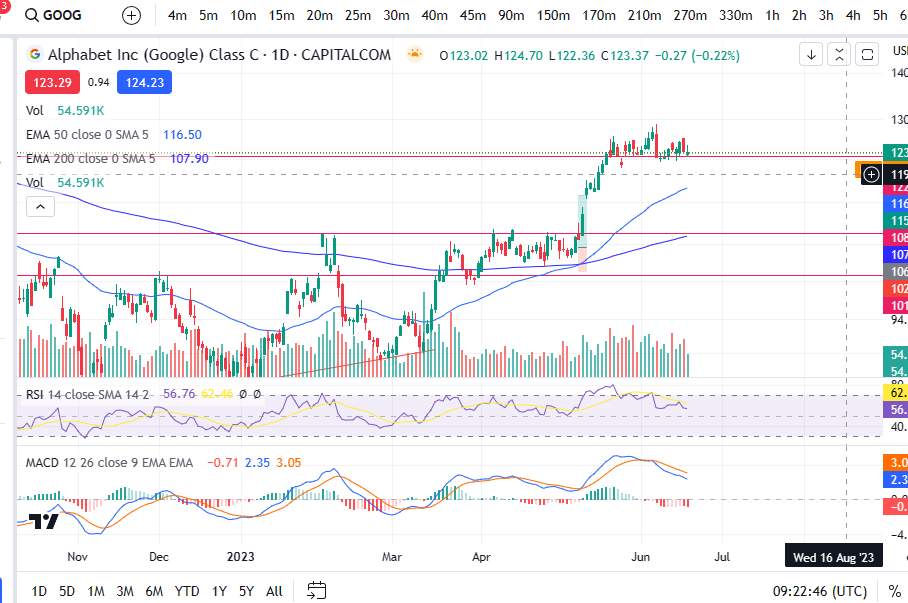
GOOGLE – recent profitable trades

This one was in more of a typical trading pattern for my sytle of trading. It had started uptrending strongly after reaching overall lows. There was a support level at around the moving average cross overs and I entered at this point on 9th May, when the MACD was just about to cross. The price reached up out of a consolidation zone and hit it’s target on 11th May.

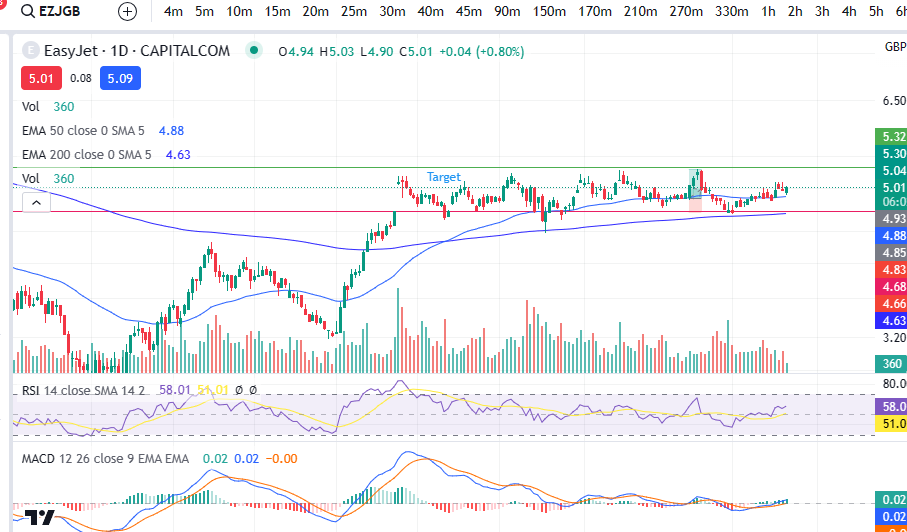
Easyjet

This was another one which was not in my typical trading pattern….. I don’t usually trade consolidations. You can see the price was moving sideways between quite a narrow channel. It made a MACD cross over at my entry point and I set my target for previous highs. This one was another profitable trade.

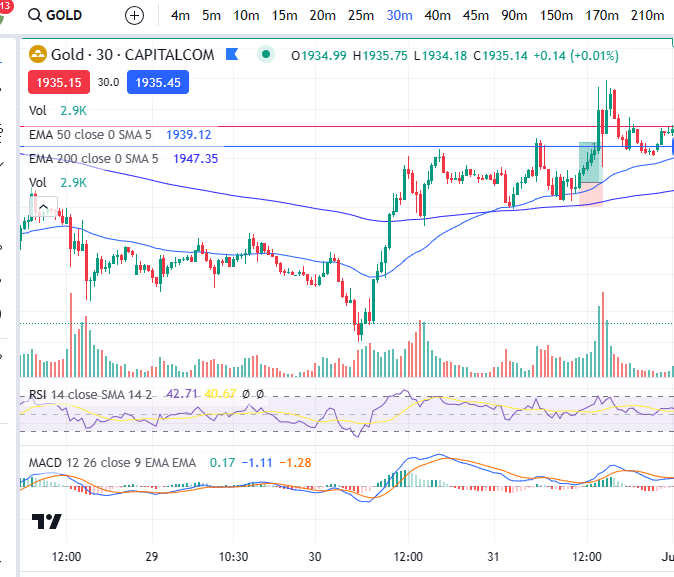
GOLD:

30m timeframe:

This trade was very typical of what I look for and it was profitable. I first checked the daily timeframe to make sure that the price was uptrending in the candles and the MACD. On the daily timeframe the price had just bounced away from a support level with a MACD cross over below the zero level of the histogram. Next I zoomed in and got in and out of the trade using the 30 minute timeframe above. I waited for a MACD cross over on the 30 minute timeframe and set my target for around the previous high.

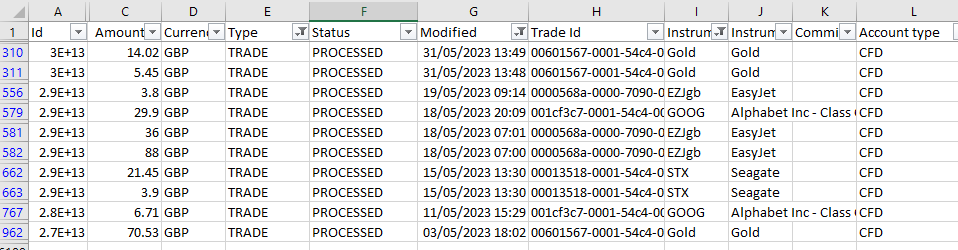
For transparency I have copied below the relevant entries in my trading account.

Some recent profitable trades

Just to be clear, not all trades were profitable in May. I made a loss on Shell and a couple of other markets.
I hope you enjoyed this digest. Please check our other blog posts for helpful trading tips and resources: Trader Pro – Trading strategies for success in the financial markets (trader-pro.co.uk)

If you would like to use the charting software above, we highly recommend Trading View to you. Use the following link and you may receive a discount on your subscription: https://www.tradingview.com/?aff_id=117138&source=TraderProBlog

Please note any subscriptions taken via my affiliate link with Trading View may result in me earning a small commission.  However, I provide complete transparency on me using Trading View personally – I publish my success on the financial markets via my broker reports and any profits earned were done so by using my own Trading View subscription,  so I genuinely do recommend them and have been using the Trading View charts for many years.

Will the UK elections cause huge growth in the UK economy? Everything you need to know…

The question of whether or not the UK elections will cause the UK economy to grow, is an interesting one, and one which we consider below. We consider the impact of previous elections on the FTSE 100 index as well as the impact of Brexit. Let’s take a look!

The previous three UK elections and their impact

The followingUK elections took place previously:

  • 12 December 2019 – Conservatives
  • 8 June 2017 – Conservatives elected
  • 7 May 2015 – Conservatives elected
  • 2010 – Conservatives and Liberal Democrats elected under coalition
  • 1997 – 2010 – Labour was in power

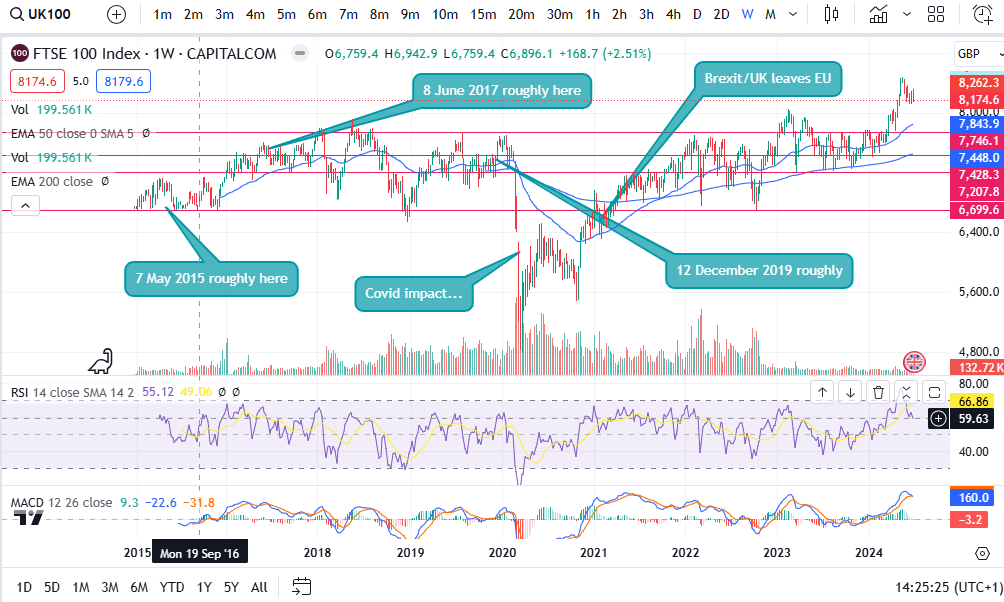
OK… So now we know the history of who was elected previously, let’s compare this to the movements on the FTSE 100 index…:

UK elections

As you can see the first time the consercatives were elected in 2015, the economy did start to grow. This continued until around June 2018 when the economy started, what I refer to as ‘stagnating’. It was moving sideways from the highest peak, until the Covid issue for a period of nearly two years. Obviously Covid’s impact was to drop the share prices like a ton of bricks! There was a sharp recovery to a point from Covid up to the time we finally left the EU via Brexit. From this point onwards, the growth in the economy has outstripped any performance previously. It seems when we are being told that Brexit has had a terrible impact on the economy, we are in fact being lied to. (I do accept that businesses have got a lot more admin to deal with, but it seems notwithtstanding this, the economy bounced back from Covid and exceeded any of its previous achievements). The economy has now reached its highest highs ever recorded!

My trading view charts do not go back far enough to consider what happened when Labour were in power. However, I found some information on the following website: https://www.statista.com/statistics/261764/annual-development-of-the-ftsenull-index/

According to this website’s charts, the value of the UK economy bounced around when Labour was in power. It seemed to have two peaks where the second did not outperform the first so it was not really growing.

What will the next UK election do to the value of our economy?

Considering it’s possible for Labour to come into power, we can probably expect the economy to start stagnating again. With either the Conservatives or Labour, it seems they were both against the Brexit vote, (they seemed to have spent more time trying to ‘undo the vote’ rather than implement it, and they were both on the same page on this. Given the Brexit vote seems to have had the most dramatic effect on our Economy in a good way and these two main parties were against it from the start, indeed they were arguing there would be absolute catastrophy as a result of Brexit, it’s very difficult to say what we can expect of them or how much, what they say, can be trusted!

The writer is unclear about what will happen but we do have the history there under each party as a slight indication of their performance. It seems however, that the UK citizens actually know better than both of them!

I hope you enjoyed this article.

For more great tips and advice on trading the stock market, please visit:

https://sophiatrades.co.uk

To watch me trade live please visit my patreon page here:

https://www.patreon.com/Traderpro8320

Finally, if you would like to receive a discount on the Trading View charting software I use, please click on the relevant link here:

https://www.tradingview.com/?aff_id=117138

Some recent profitable trades – how to make money

Some recent profitable trades – how to make money

In this blog post I cover a couple of recent profitable trades placed. I will break down my entry and exit points. I hope you find this useful!
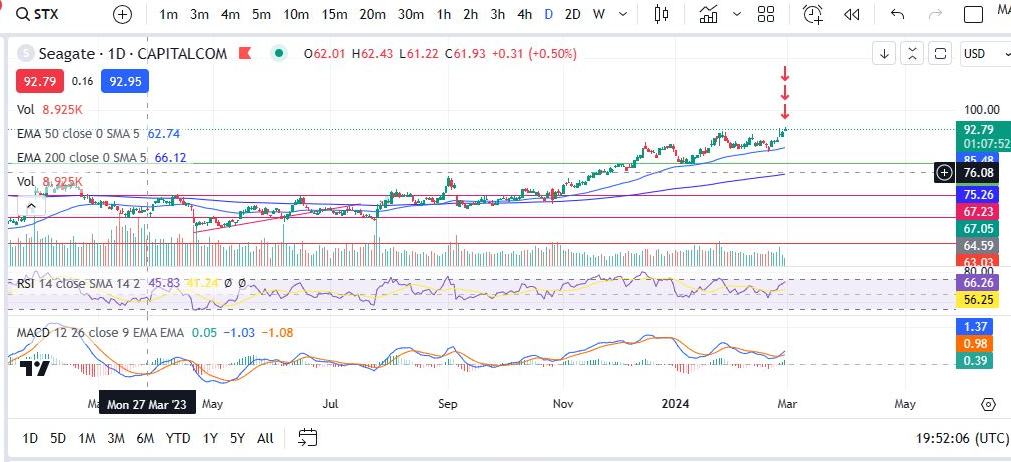
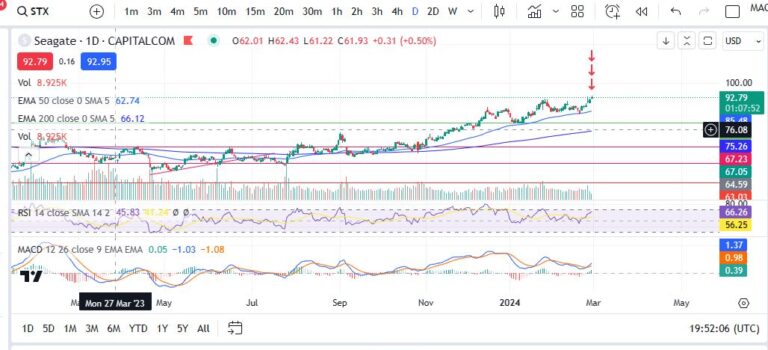
Seagate

Recent profitable trades

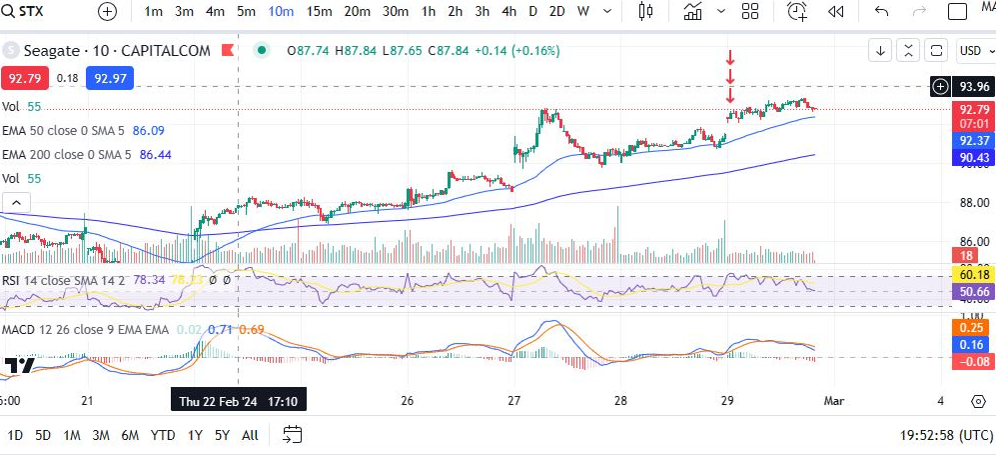
I first looked for an entry on the daily timeframe. The MACD had just made a cross over. The market was in an uptrend. The RSI was not too high. Next I checked the ten minute timeframe for an entry point:

Same thing again – looking for an entry on the MACD indicator where the MACD and signal are about to cross and ideally they are below the histogram. In this case They were low on the histogram but not quite below the zero line. The RSI had taken a dip. I set my target for the previous hight of the trend.

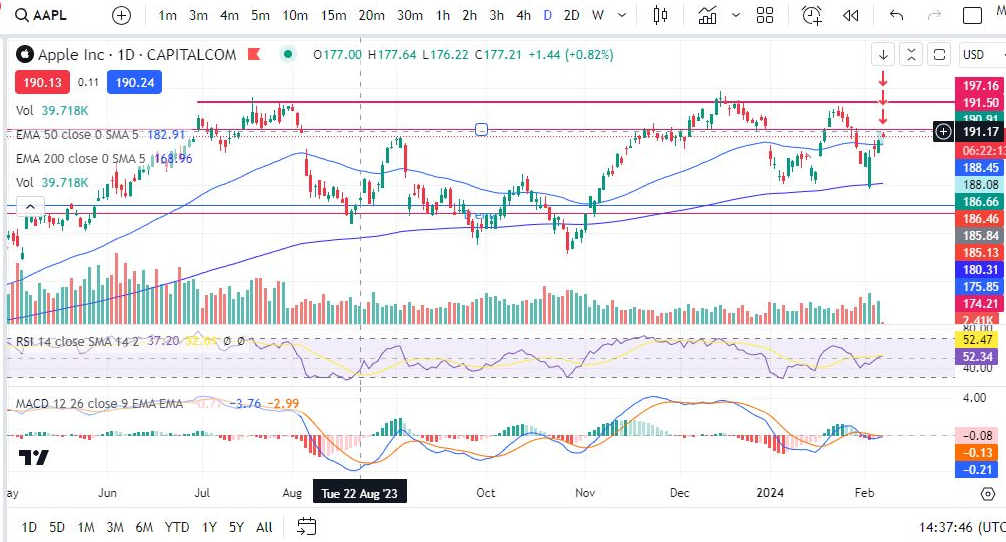
Recent profitable trades – Apple

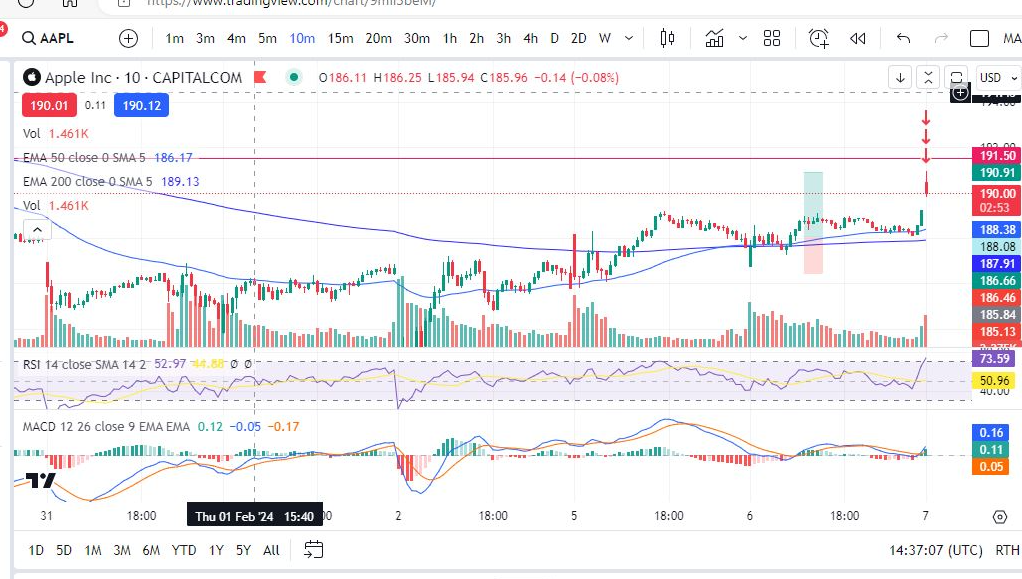
Looking foran entry point, the MACDhad crossed over, was below the histogram zero level and the RSI was low. I then checked the 10m timeframe for an entry point:

The MACD had just made a cross over. Iset my target for a bit higher than the previous high. The RSI was low and the market had started to uptrend (above the 200 period EMA). Sure enough the trade reached its target!

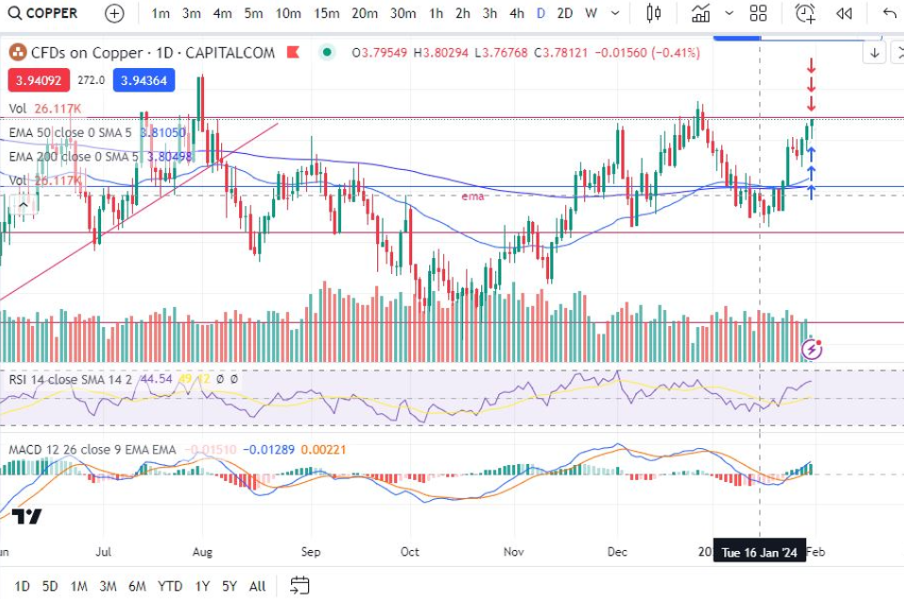
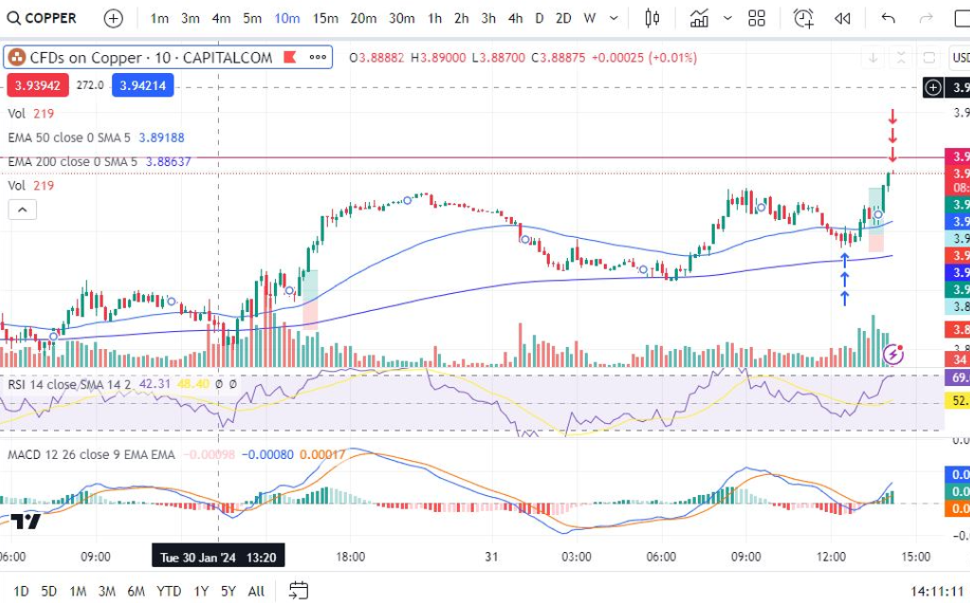
Copper

Again, I checked that the MACD was in a good place on the daily timeframe. I also checked whether I would have enough room to reach a decent profit target before hitting the resistance level marked on the chart with the red line above.

Then I checked the ten minute timeframe for an entry point:

I set the profit target on this one for just below the red resistance level marked on the daily timeframe. I waited for a MACD cross over and the trade reached its target shortly after.

For more great tips and advice on trading the stock market, please visit:

https://sophiatrades.co.uk

To watch me trade live please visit my patreon page here:

https://www.patreon.com/Traderpro8320

Finally, if you would like to receive a discount on the Trading View charting software I use, please click on the relevant link here:

https://www.tradingview.com/?aff_id=117138

Please note any subscriptions taken via my affiliate link with Trading View may result in me earning a small commission.  However, I provide complete transparency on me using Trading View personally – I publish my success on the financial markets via my broker reports and any profits earned were done so by using my own Trading View subscription,  so I genuinely do recommend them and have been using the Trading View charts for many years.