What makes more money – paying off debt or investing?

What makes more money – paying off debt or investing?

This is a really interesting question and it’s one people can get wrong and end up wasting precious time with unless they know how to answer it for their own situation. Mostly the answer re whether you should be paying off debt or investing, comes down to the interest or earnings rates in question but there are some important other considerations, and I would like to demonstrate to you, how profound the impact of this decision can be – either in a good, or bad way!! Perhaps you want to create your dream life with supercars and a peacefulness of knowing that everything is taken care of… I hope this article will be a help in you getting there…Let’s jump straight into it…

So should you be paying off debt or investing? It’s all about the rate… – well… mostly!

Let’s say you have a loan worth £10k and the interest rate on this loan is about 6%. If you are considering paying off this loan instead of investing your money in the stock market, my suggestion is that you don’t! There are a couple of caveats which I will go into below, but on the face of it, it would not be wise to clear down the loan. I started my career as a chartered accountant and many thinks make sense to me in terms of what the numbers are saying… so let’s take a look…

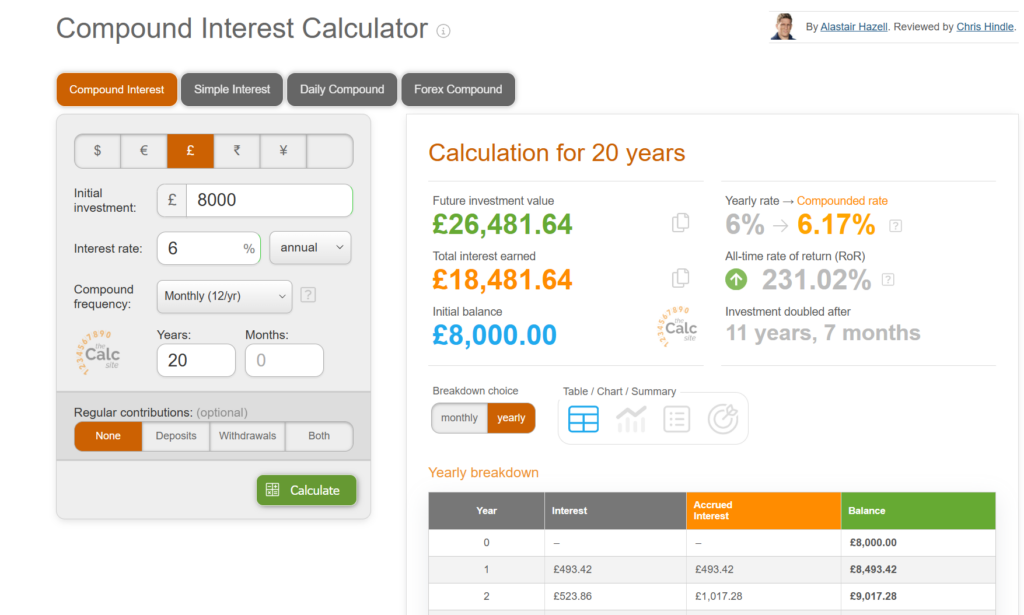
Imagine the scenario where the loan is not getting cleared in terms of capital repayment (so the worst scenario for the loan) and it’s at a rate of 6% interest. Let’s also suppose that this loan will continue to incur interest for the next 20 years. I’ve put these details into the Compound Interest Calculator – here’s a link:

Compound Interest Calculator – Daily, Monthly, Yearly Compounding

I absolutely love playing around with this calculator because it’s like a crystal ball which tells me how rich I will be in the next 10 to 20 years.
paying off debt or investing

OK, so we said a loan of £8k at a rate of 6% with no capital repayments. As you can see above, after a 20 year period, the amount of interest paid relative to the loan appears to be colossal… this is not insignificant in your decision about whether you should be paying off debt or investing, but I wonder whether it will look so big when we compare it to the scenario where instead of clearing down the capital of this loan, the £8k is instead, used to invest in the stock market…

Let’s run the calculator again:
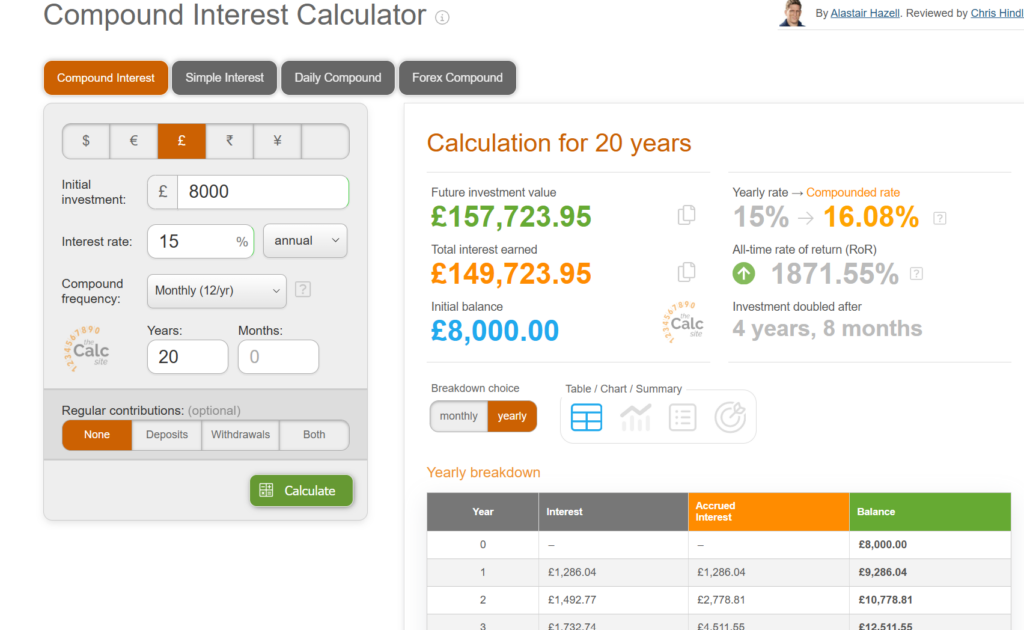
OK, so as you can see I added exactly the same details but just changed the rate. The rate of 15% is not unreasonable in terms of the rate which can be achieved on the stock market, especially when investing in something like the NASDAQ or the S&P 500 – I put the question into Google for you and this is what it answered:
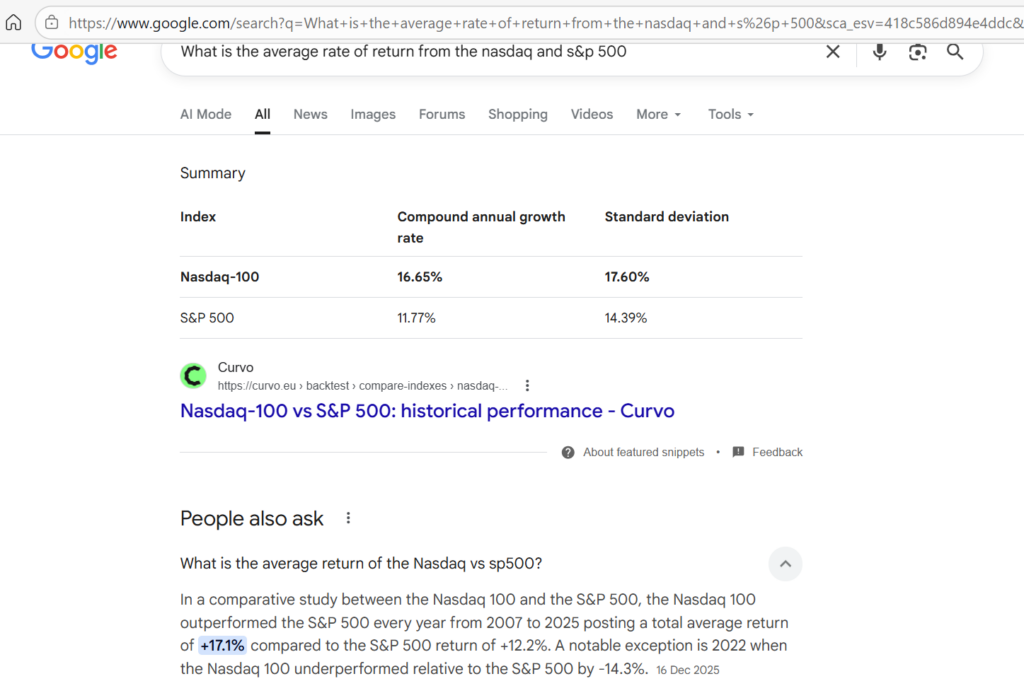
So if you chose instead to invest your money in the stock market as opposed to clearing the loan, you would end up £157,723 – £26,481 = £131,242 better off. You could use some of the investment to clear the loan at that stage but even then!! My suggestion would be to let the investments earn money to ‘slowly pay off’ the loan in instalments! While it’s doing that, the investments are growing still! The answer is infinite when there is a difference in rate, in your favor! I hope this has given you some more clarity on the question of whether you should be paying off debts or investing.

Now, we must acknowledge here, that if you have high interest debts it is better to clear them – because the rate on the debt will be higher.

If you have very low interest debts they lend more weight to the idea of not clearing them and instead, investing the money.

Caveat: I am not a financial adviser – you should consult one before doing anything if you are unsure.

A caveat for you!

OK, so I said there would be a caveat and it’s this: if you are paying off debts, even where they are on a lower rate of interest and you would get a better return on the stock market, it may still be necessary to clear them a bit first – in the scenario where our outgoings are far too high and you are struggling to make ends meet. If finances are a struggle in general and the loan feels like a noose around your neck, it may be good to clear it first. However, just know, once you get to the comfortable stage, if the loan rate of interest is lower than what you can get on the stock market, you would do well to think ‘long term’ and invest the money.

Some inspiration for you- what can you achieve by investing more?

I wanted to share with you some more examples of how much your money could grow over a 10 to 20 year period, especially for someone who is young, but for older people, it’s never too late, and I did write another article on this which is linked below.
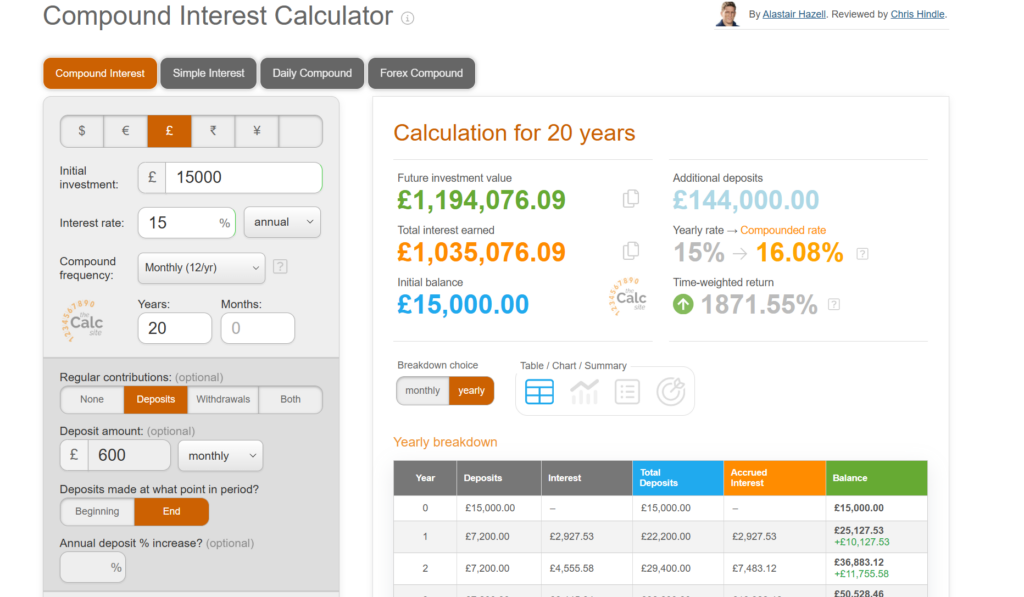
OK, so same calculation again but this time with a higher starting balance and a monthly contribution of £600. This would literally make you a millionaire after 20 years. I know £600 per month is very difficult for some families – especially in the UK but it would still be best to invest as much as you are able. Perhaps you are younger – 18? You could take slightly longer and just put money away more slowly! This is why I like to play around with the calculator.

As promised, here is the video I published about becoming a guaranteed millionaire:

Disclaimer!

Nothing on this blog should be taken as financial advice or encouragement for you to enter a trade.  You are expected to speak to a financial adviser or carry out your own due diligence before entering any positions.  Everything on this blog is made for educational purposes and to equip you with the knowledge you need to be able to make your own financial decisions.

For more great tips and advice on trading the stock market, please visit:

https://sophiatrades.co.uk

To watch me trade live please visit my patreon page here:

https://www.patreon.com/Traderpro8320

Finally, if you would like to receive a discount on the Trading View charting software I use, please click on the relevant link here:

https://www.tradingview.com/?aff_id=117138

Please note any subscriptions taken via my affiliate link with Trading View may result in me earning a small commission.  However, I provide complete transparency on me using Trading View personally – I publish my success on the financial markets via my broker reports and any profits earned were done so by using my own Trading View subscription,  so I genuinely do recommend them and have been using the Trading View charts for many years.

How does a dividend affect a share price?  Everything you need to know!

How does a dividend affect a share price? Everything you need to know!

How does a dividend affect a share price? This is an important topic for any trader and definitely something you should be considering before placing any trade – both in general and in relation to the timing of the specific stock you are interested in trading. I’m going to talk about what a dividend is, how this affects the price of a stock and how you can prepare for these fluctuations as a trader.

We want to answer, “How can a dividend affect a share price”, but first of all, what is a ‘dividend’?

So…. back to companies 101…. we know that a company is a business (or it can be an investment vehicle) in a legal entity ‘wrapper’. It is treated as a separate person entirely, from the business owner(s). The business is split into portions like dividing up a pie and these portions are the ‘shareholdings’ of the company. So the people who own the business are the ‘shareholders’ and they each own a piece of the company in accordance with their share holding and certificate, like a slice of pie. A dividend is a mechanism by which, the business pays out some profit to its shareholders.

So how do dividends come about?

In order to determine an answer to the question, how does a dividend affect a share price, we must first also understand how dividends come about! Any assets or income belongs to the legal entity of the business and is received within the legal entity. In order to distribute some of this income to the owners of the business (the shareholders), a ‘dividend’ must be declared and paid. The business will declare a dividend from ‘distributable profits’ only. If they do not ensure the dividend is made from ‘distributable profits’ it is possible the dividend will be made illegally. This is a slightly different topic but the directors basically need to ensure that the business has got enough cash and spare money before paying the shareholders a dividend, to make sure it is being fair to its creditors. The worst case scenario which could occur is that the company could pay a dividend and it depletes funds needed to pay creditor liabilities – this is why they must be paid from ‘distributable’ reserves. This is a slight digression, but it was worth noting here for anyone who does not know much about companies and how they work.

OK, so back to where we were… the directors of the company will assess whether the company is in a position to pay a dividend, and they will ‘declare’ it / in other words, they will announce to the market, that they have decided a dividend will be paid. This is the ‘ex dividend’ date – which is important. The cash payment of the dividend will follow a little while later and will be paid to the share holders in accordance with their slice of pie share holding. So if the company is divided up into 10 slices of pie (shareholdings) and they are all equal shareholdings, and the company declares a dividend of £800, what this means is that each slice of the pie shareholding will receive £80 as a dividend.

Are dividends mandatory?

No – dividends are not a mandatory thing on the part of the directors. They need the freedom and discretion to be able to examine the company’s financial position, prior to making any dividend declaration, and consider whether the company can afford to make a dividend from its distributable reserves.

Not only this, but some companies do not usually pay dividends and other ones do. It is entirely in the discretion of the directors and they are usually following the particular customs of the company in question. If a company usually pays a 1% dividend to shareholders, the shareholders would be in a position where they are accustomed to receiving this, and they would expect it. Indeed, it may be the reason they purchased those shares – some shareholders just purchase shares for the purposes of receiving dividends, and some shares pay more dividends, and pay more ‘often’ than others – so if the investor is someone who is interested in receiving dividends as income rather than more capital growth from his/her shareholdings, they may tailor their investment portfolio to the companies which pay dividends regularly and at a good rate. Notwithstanding this, the discretion of the directors must always be applied to ensure the dividends are not made illegally (from non distributable reserves – depleting funds for the creditors).

So how does a dividend affect a share price then?

So when a company makes a dividend, this dividend is in effect, the company paying out some of it’s earned profits to the shareholders. The company’s worth (share price) is based on it’s assets and earnings potential – it’s an estimate by the market based on supply and demand, of what people think that is worth! So when the company pays out some of it’s worth as a dividend, it is literally depleting the balance sheet of reserves and profit/cash – which could be used to buffer the company from any troubles, buy more assets, grow the business etc. I’m not saying paying a dividend is a bad thing but it ‘must’ affect the share price – logically, it will.

So when the stock goes ‘ex dividend’ (when the dividend announcement has been made), you can expect the stock to take a temporary nose dive in terms of the share price.

How can you plan your trades around this?

Make sure before you open a position on an equity, that you know what the next ex dividend date is, and be prepared in the plan of where to enter and exit, for the drop in share price when the stock goes ex dividend. If you are confident that there will be no significant impact from the question, how does a dividend affect a share price that’s fine… but it could affect your win rate if you ignore this and get in anyway!

I hope you found this article informative on resolving the question, how does a dividend affect a share price. Perhaps if you did, you can leave a comment below!

Disclaimer!

Nothing on this blog should be taken as financial advice or encouragement for you to enter a trade.  You are expected to speak to a financial adviser or carry out your own due diligence before entering any positions.  Everything on this blog is made for educational purposes and to equip you with the knowledge you need to be able to make your own financial decisions.

For more great tips and advice on trading the stock market, please visit:

https://sophiatrades.co.uk

To watch me trade live please visit my patreon page here:

https://www.patreon.com/Traderpro8320

Finally, if you would like to receive a discount on the Trading View charting software I use, please click on the relevant link here:

https://www.tradingview.com/?aff_id=117138

Please note any subscriptions taken via my affiliate link with Trading View may result in me earning a small commission.  However, I provide complete transparency on me using Trading View personally – I publish my success on the financial markets via my broker reports and any profits earned were done so by using my own Trading View subscription,  so I genuinely do recommend them and have been using the Trading View charts for many years.

Are the markets going to drop in 2026?  Everything you need to know!

Are the markets going to drop in 2026? Everything you need to know!

Many traders and investors are asking the question ‘Are the markets going to drop in 2026?’. In this article I take a look at the current state of the markets and whether a drop could be possible and most importantly, what you can do if they do drop and in the meantime! Let’s get straight into it!

Are the markets going to drop in 2026? Where are they right now?

Currently many of the most popular and most liquid markets, are very overbought. They have reached record highs. Let’s take a look at some examples:

Are the markets going to drop? – Gold

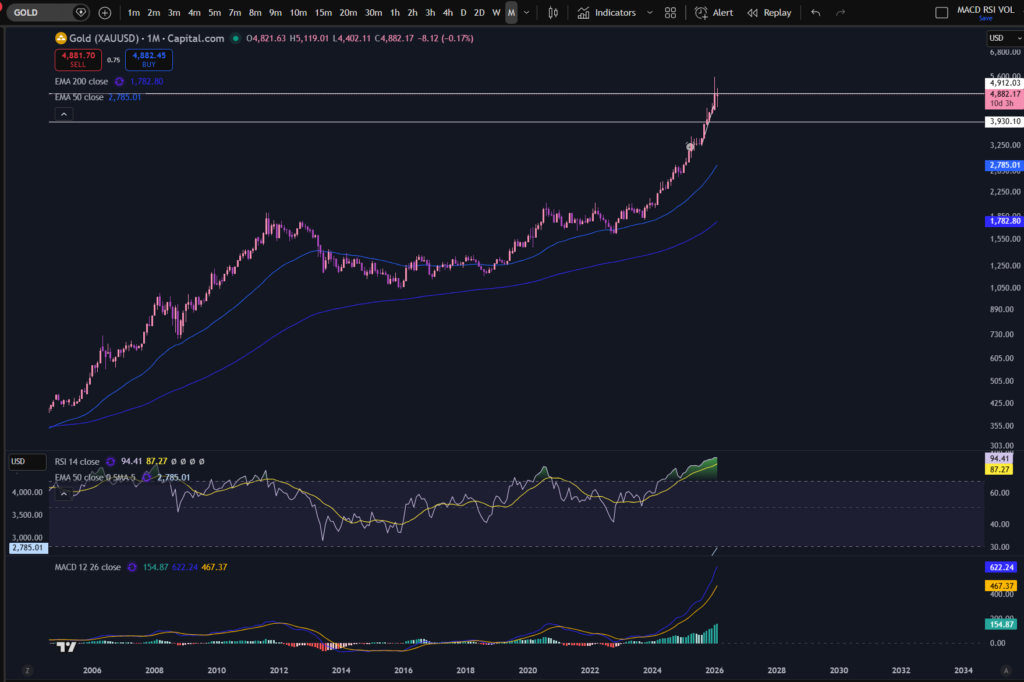
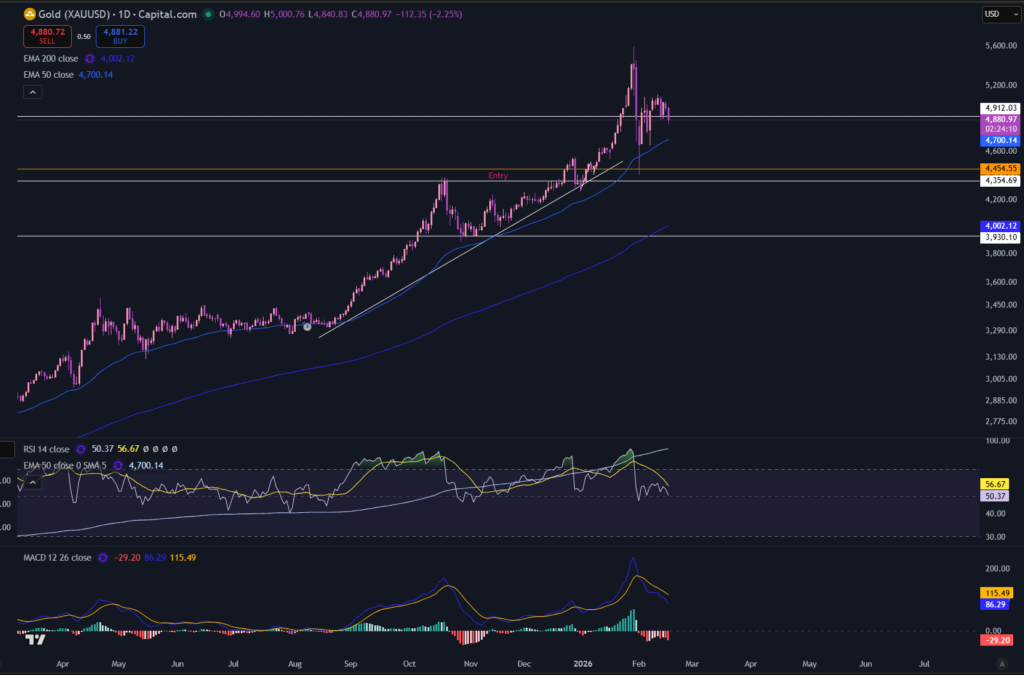
Gold has reached record highs. The chart recently reached a price of circa 5,615 USD but they took a slight downturn from this – let’s take a look at the chart to see if we can get start to answer the question, are the markets going to drop in 2026:

markets going to drop

As you can see from the daily chart, Gold has pulled back from it’s peak. Let’s take a look at what’s going on, on the monthly chart, as this can give a better ‘birds eye’ view:

As you can see on the monthly chart, Gold has reached record highs. The RSI is currently very overextended and it wouldn’t be surprising if the market were to pull back farther than the little dip it’s made on the daily timeframe. However, nobody can predict whether the markets are going to drop – or what they are going to do. The FEDS have cut interest rates in America and this can have a positive effect on some of the markets. We are in a bit of an unprecedented situation. History tells us that when so many markets reach these types of highs, they do pull back quite a bit. It may be just a question of time!

Let’s take a look at the NASDAQ…

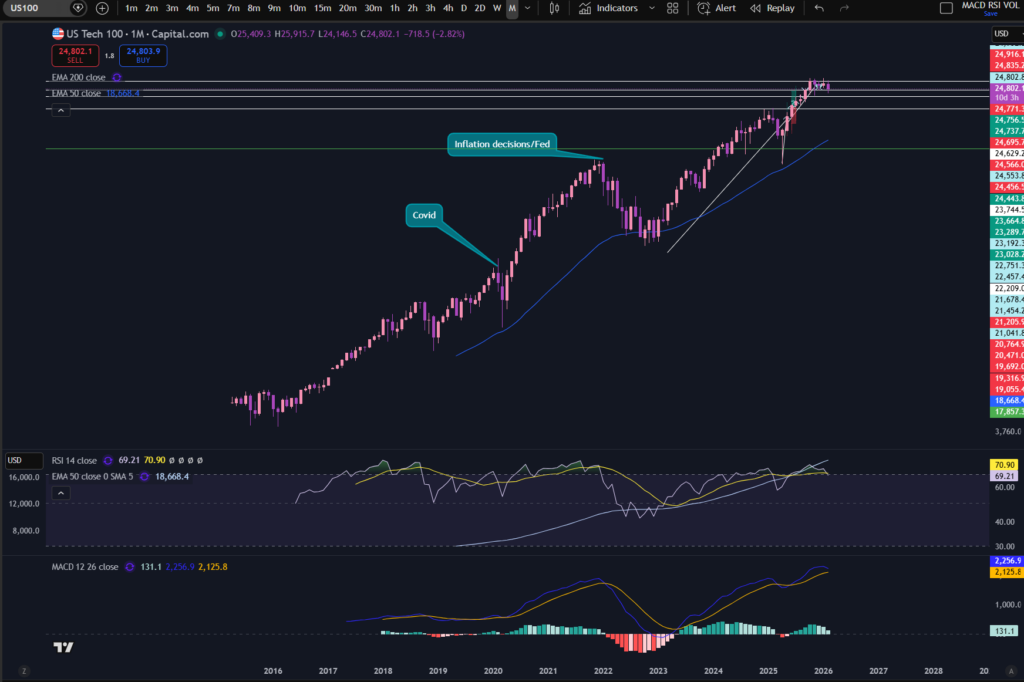
Are the markets going to drop? -NASDAQ

As with the case of Gold, you can see on the monthly timeframe, that the NASDAQ has sailed sky high. Take a look at the RSI and the MACD which is now bumping over to the downside! The green histogram bars on the MACD indicator are losing their pigment meaning they are losing strength currently and they are becoming smaller in size! For information I have added what happened to the markets during Covid and also the inflation struggles which have happened over the last few years and the effect of the FED’s interest rate increases on the markets.

The soaring prices on the NASDAQ have partly been inflated by expectations concerning AI and future profitability predictions surrounding this. Some people believe the AI bubble could burst. Nobody truly knows what will happen, however.

Let’s also take a look at the S&P 500 chart for good measure!

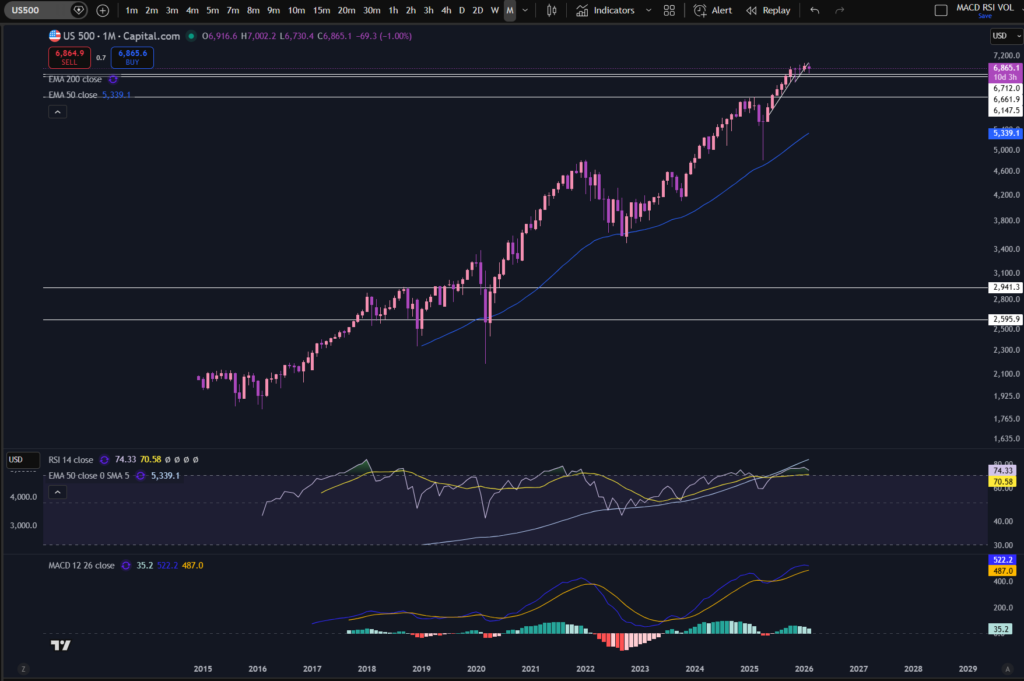
S&P 500

As you can see, it’s the same story on the monthly chart for the S&P 500! RSI over extended, MACD bumping over, prices at record highs.

So what to do in the scenario that the markets do ‘pull back’

Try and keep some money aside to take advantage of them on their way back up. Experienced traders and investors do not panic when the markets drop – they have dollar signs in the eyes! There is a saying that most profit is made at the time of purchase, not sale! The wealthy investors will be watching and waiting, and going shopping at the relevant time! Will you be one of them, or will you start panicking? Which one do you want to be?

It’s a good idea to do some research before the markets pull back, into which solid stocks could generate solid returns after some time. It’s a good idea to pick stocks with healthy balance sheets, in sectors which are likely to do well, and try and be diversified to hedge your risk. I posted a video on how you can carry out fundamental analysis of a balance sheet or profit statement, which you may find helpful:

Traders can manage risk in a slightly different way – there are plenty of articles on this blog about how you can manage risk. Currently, for example, I am entering small positions until the market starts moving in my favour and then I load up. This is similar to the averaging up which investors do, but I do this in trading now as well.

Conclusion – are the markets going to drop

My strong suggestion to you is to not fear the question ‘are the markets going to drop’ but rather see the this as an inevitable situation and a significant money making opportunity! Plan for the drop to happen – it will, periodically! Keep cash aside for these times to be in the best possible position, to take full advantage.

I also prepared a YouTube video on this issue which you may find helpful to watch:

Disclaimer!

Nothing on this blog should be taken as financial advice or encouragement for you to enter a trade.  You are expected to speak to a financial adviser or carry out your own due diligence before entering any positions.  Everything on this blog is made for educational purposes and to equip you with the knowledge you need to be able to make your own financial decisions.

For more great tips and advice on trading the stock market, please visit:

https://sophiatrades.co.uk

To watch me trade live please visit my patreon page here:

https://www.patreon.com/Traderpro8320

Finally, if you would like to receive a discount on the Trading View charting software I use, please click on the relevant link here:

https://www.tradingview.com/?aff_id=117138

Please note any subscriptions taken via my affiliate link with Trading View may result in me earning a small commission.  However, I provide complete transparency on me using Trading View personally – I publish my success on the financial markets via my broker reports and any profits earned were done so by using my own Trading View subscription,  so I genuinely do recommend them and have been using the Trading View charts for many years.

I made 180% profit  trading Google within a few months

I made 180% profit trading Google within a few months

I made 180% profit trading Google within the space of a few months and I wanted to explain to you how I achieved this. In this article i’m going to talk about my entry points, why I selected Google to trade, where I planned to exit and how I averaged up in this trade which is an approach I’ve been using more recently, to handle the turbulence in the markets, and Donald Trump’s announcements!

I made 189% profit trading Google, but why did I chose to trade Google Class C to begin with?

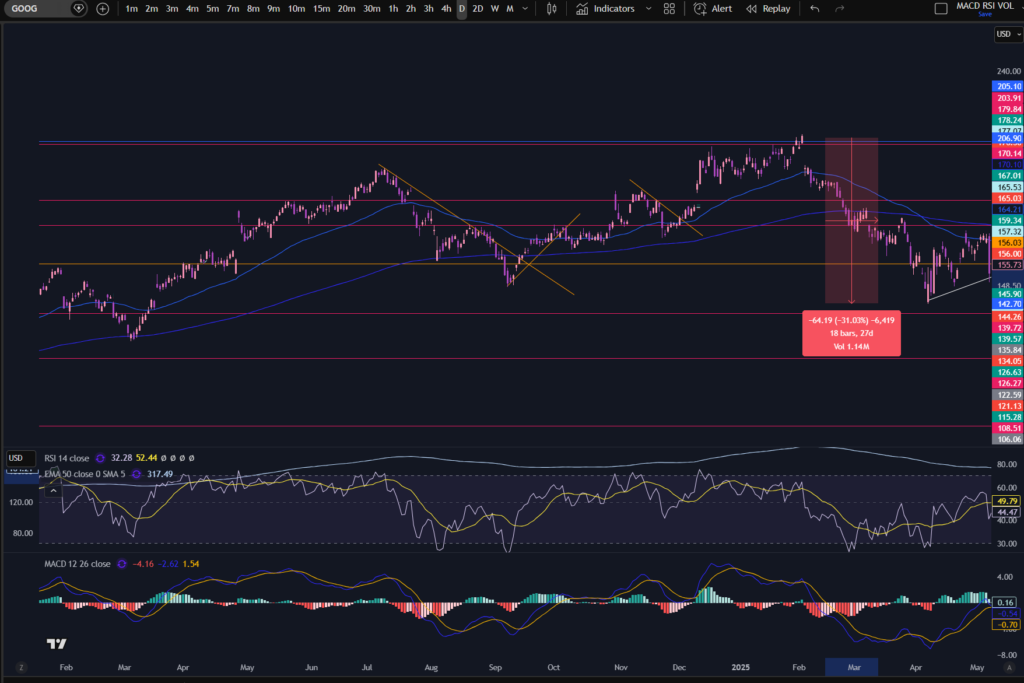
I chose to trade Google Class C because I had identified an opportunity. This is a successful company which is investing in modern technology. It has a good product range and I considered it is not likely to go into liquidation, any time soon! The price had dipped right down due to Donald Trump’s tariffs and other news releases. I saw a large opportunity:

profit trading google

If you would like to use the Trading View software pictured above, in your analysis, I can get you a discount – click the link below:

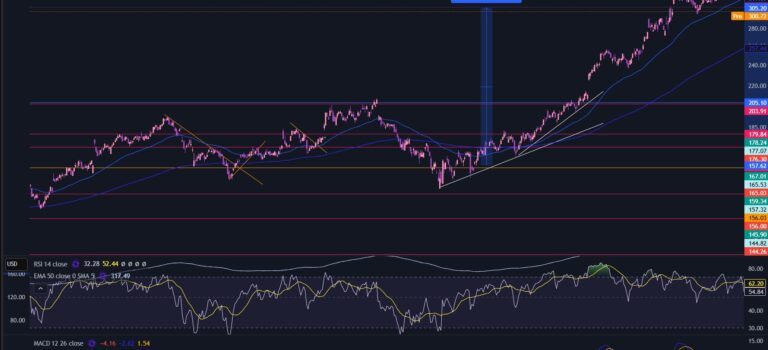
The price had dipped right down by about 30% as you can see in the above chart. This happened in the Summer of 2025. I had predicted that the price would return back up to previous highs and potentially beyond… and I would end up making a large profit trading Google – and this is exactly what it did.

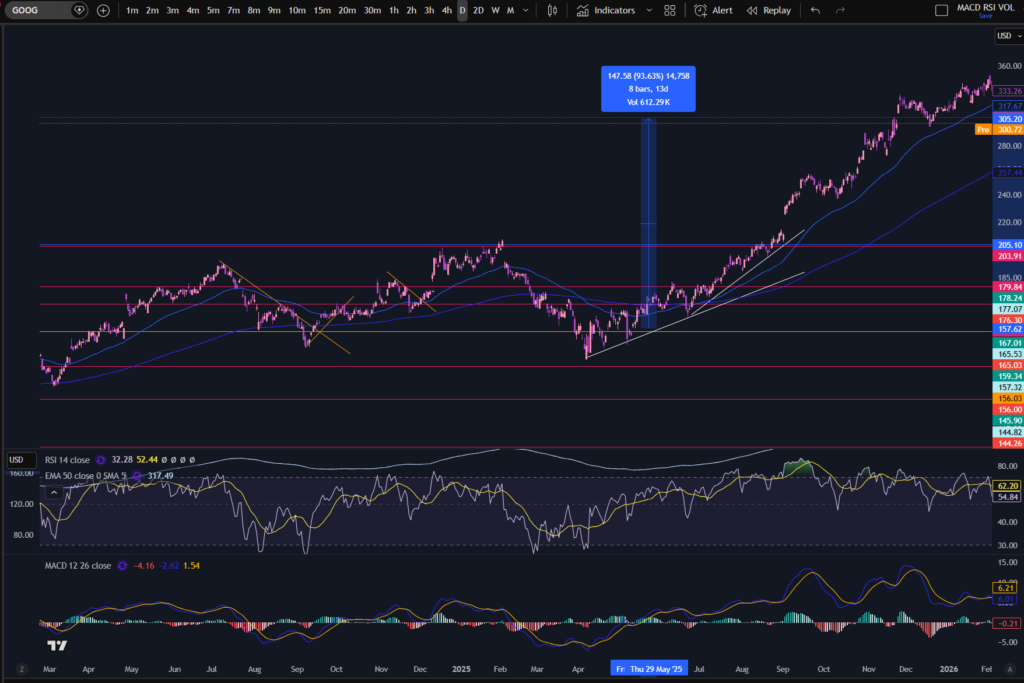
I got in near the bottom where you can see I drew a diagonal support line above.

I took a smaller position size to begin with. This is a new approach I have adopted as outlined in one of my previous articles (here):

How President Trump is affecting the stock market – Trader Pro – Learn how to Trade the Stock Market

My latest approach is to take a smaller position at the outset and then add to this as the position goes in the direction of my favour, instead of using a stop loss. This is what happened afterwards:

You can see in the chart above, that the market actually returned about 90% profit in the time I was in my trade, but how did I make 189% profit trading Google? I loaded up as the market moved in my favour so by the time it reached the top, I was carrying quite a large position and I had scooped up several staggered entry point profit tranches, between their entry points, and the 90% ‘market profit level’ marked on the chart.

As I explained in the above linked article, this approach has made me significantly more money while trading the stock market – President Trump did me a favour in my trading style! I could not be more grateful to him for the turbulence he created.

I consider the sky really is the limit in my trading now and I’m excited to continue with this approach. Thanks Trump!

Let’s generate wealth independently, together!

Understand my strategy in full:

My trade set up/Watch me | Collection from Sophia-Trades | 1 post | Patreon

If you find it more helpful to watch a video you can see my YouTube post in relation to the profit trading Google which I made, here:

https://youtu.be/GzrR1mXELG8

For more great tips and advice on trading the stock market, please visit:

https://sophiatrades.co.uk

To watch me trade live please visit my patreon page here:

https://www.patreon.com/Traderpro8320

Finally, if you would like to receive a discount on the Trading View charting software I use, please click on the relevant link here:

https://www.tradingview.com/?aff_id=117138

Please note any subscriptions taken via my affiliate link with Trading View may result in me earning a small commission.  However, I provide complete transparency on me using Trading View personally – I publish my success on the financial markets via my broker reports and any profits earned were done so by using my own Trading View subscription,  so I genuinely do recommend them and have been using the Trading View charts for many years.
How to escape the corporate hell as a woman

How to escape the corporate hell as a woman

Hi guys! So I want to talk to you about your corporate jobs. Maybe you are not doing a corporate job, but some other job… a job that you hate. A job you do to earn money – it’s sucking the life out of you, and you’re not sure how you can keep doing it. I want to talk to you about some things which can help you to keep going if you are in this scenario (until your escape)… If you are a woman who wants to escape the corporate hell, this article is aimed at helping you… let’s get straight into it!

escape the corporate hell

Some things which can keep you going while you are waiting to escape the corporate hell as a woman…

If you are desperate to escape the corporate hell, you want to have a plan for your self – an exit plan. On this blog I help women learn to trade and invest in the stock market. If you are terrified of trading, you can be more of a passive investor rather than trader and it will still provide you with an exit plan from your corporate hell job. Investing will take a long time – I know what you are thinking! But here’s the thing… do you want to be someone who is completely free in ten years’ time, or someone who is still STUCK IN THE CORPORATE HELL in ten years time? Imagine that!

Those ten years will go by either way. You are going to get there. You will go through those ten years no matter what. At the end of those ten years, you will either be Sarah or Marylin who still works in her awful corporate job or you will be someone who took control ten years ago and freed yourself.

I’ve given advice on my youtube channel and other blog articles about how long it will take for you to become a guaranteed millionaire. Here’s a link to my youtube video on this:

You just need a plan for yourself and you need to stick to it with complete discipline. When you have that plan in your head, it helps you to keep going. The office politics and garbage which goes on in your corporate hell job, where men take credit for your work and you need to work three times as hard as them to get half of the recognition and pay….all of this garbage which goes on and consumes your energy, will no longer be relevant. You will surpass these people. In ten or twenty years time, they will just be distant memories. You will look back and laugh. So i’m guessing after listening to the above video, you now have a plan in mind about investing and your exit/escape, and at what point your exit can literally happen – a guaranteed date in the future, based on the rate at which you can invest.

Some things which can help you on your journey…

Let’s talk about the things which can help (or hinder!) you… I’ve been there, in all walks of life – I used to have a Central London job, commuting on the train every day… each morning, I would buy a latte and a croissant from Costa Coffee… in those days it used to cost about £4 or £5 per day. That was over ten or 15 years ago. These days it’s probably costing a lot more. If I told you how much this would cost over a ten year period, in lost investment opportunity, (or 20 years – even worse!), you may be very horrified… Let’s take a look:

Ten years of spending £5 per day on a coffee and snack in the morning will set you back c.£29,000 in lost investment earnings at an assumed stock market return rate of 15%. Please see the Compound Interest Calculator website, as explained in my above video!

Twenty years of spending £5 per day will cost you a whopping £162k….

Yes, you read this correctly.

One hundred and sixty two thousand pounds, over a twenty year period – on croissants and coffee.

At that point in time, if you had accumulated those funds in the stock market, the return (and therefore, yearly income) would be £162k x 15% = £25k per year, annual income.

So let’s sum that up… if you choose to put your £5 per day into an investment account and keep doing it for 20 years, you will have achieved a capital balance which would be enough to live on in some countries – example, it can cost 1,000 euros per month in living expenses in some of the European countries like the Greek islands, Portugal etc. Half of your annual income on your saved coffee money. You would live like a king in Thailand or somewhere similar I bet!

That could be an escape right there – without any further effort on your part! OR… You could have your coffee and snack on your way to your big corporate hellish job, every day, for the rest of your life/till you retire and always be trapped in that? Which would you prefer? This is just the coffee and croissant money – I’m expecting you might be able to spare a bit more than that, and get your £1m by the time you quit the corporate hell – then you can literally do whatever the hell you like, and live wherever you want.

Don’t forget, you can always buy a multi pack of croissants from Aldi each week and just take one with you! It doesn’t need to be complete suffering and austerity! Get yourself a lovely travel mug and take a nice coffee with you as well! This is also better for the environment so an added bonus! Obviously this lesson does not just relate to coffee – are you spending money on other things which can be avoided and the money invested instead? Lottery tickets? Newspapers? Cigarettes? Chocolate bars from the Central London shop instead of buying a muti pack from Tesco with the weekly shop? The list is endless of where you could find money to invest.

Make the corporate hell worth it…

Hear me out on this…It’s never going to be enjoyable, but overall, you want to make the hellish nightmare of a corporate job worth it in some way – for yourself. You want to be doing it, for YOU… Not your boss, not the employer, not the business. If you use the money in a smart way and built wealth and an escape route you can justify having to deal with it. It is way less justified when you spend the money on coffee and croissants and it’s causing you to be trapped in that nightmare, FOREVER.

A word on switching the corporate hell in one job, for another

So we’ve discovered we always want to have our ‘plan’ in mind while we are putting up with the corporate hell. Another issue I want to talk to you about, is ‘moving jobs’. Sometimes it’s easy to think “if I get a new job, everything will be fine” I can almost guarantee you, it won’t be. The grass will not be greener. You will get the same sorts of issues with different people and managers. All of the jobs are expecting you to work free overtime to sustain the activities of the business. It’s corruption at it’s finest. Tesco is not expected to give out free food, but for some reason, employees are expected to do free overtime and charity work for their employer…This will be the same in any job.

Here’s a reason you might want to actually move though:

  1. Your boss is a complete narcissist and it is literally destroying you, and is becoming very toxic emotionally for you – it’s way beyond normal corporate hell issues;
  2. If they are not paying you the market rate for your experience. This can happen if you are in a job for a long time, through lack of pay rise/inflationary rises. This second issue will affect your ‘plan’ because you will need to work longer to get there. So if your rate of pay is negatively affecting your plan, this would be a good reason to move.

If the issues you have in work are the bog standard, free overtime required, your boss is annoying, you have men trying to undermine you as a woman in the work place, my suggestion is you just stay there and invest more heavily and in the back of your mind, laugh at them. Laugh at the fact that you are on your way out, literally, and Derek and Bryan will still be d*ck measuring for a measly 3p per hour promotion in the office, when you are long gone.

So, to sum up, if you want to escape the corporate hell, you need to TAKE CONTROL. Make a wealth building journey ‘plan’. Work out exactly how much you need to invest regularly to become a millionaire. Write down the plan and commit yourself to your escape route. This is 100% doable. This is how the wealthy people became wealthy – by investing in the stock market.

You do not need a lot of knowledge to become a passive investor – you could put a set amount from your salary into one of the indices like the S&P 500 which is the average of the top 500 stocks in America and just leave it there and watch it grow!

Let’s generate wealth independently, together!

If it’s easier for you to digest this on a video, please see the video below.

For more great tips and advice on trading the stock market, please visit:

https://sophiatrades.co.uk

To watch me trade live please visit my patreon page here:

https://www.patreon.com/Traderpro8320

Finally, if you would like to receive a discount on the Trading View charting software I use, please click on the relevant link here:

https://www.tradingview.com/?aff_id=117138

Please note any subscriptions taken via my affiliate link with Trading View may result in me earning a small commission.  However, I provide complete transparency on me using Trading View personally – I publish my success on the financial markets via my broker reports and any profits earned were done so by using my own Trading View subscription,  so I genuinely do recommend them and have been using the Trading View charts for many years.