In this article i’m going to talk about different types of financial instruments, what they are, how they can be traded. The markets can be a minefield for new traders so it is hoped this article will shed some light on exactly what it is you are looking at, when you log into a broker account.
What are Financial Instruments?
Financial instruments can be any type of financial asset or liability with an underlying contract present giving rise to the asset or liability rights. For example, if you hold shares, you hold financial instruments. If you owe a loan company some money for the new car you just purchased, this is also a financial instrument. It’s a liability for you, but an asset for the vehicle loan company.
So what about the instruments you can see when you log into a broker account? The types you will see, will depend on whether you are logging into an account with margin, or a regular asset purchase account. I have covered what margin is, separately – please see the links below:
OK, so back to the question at hand! If you log into a margin account, you will see many ‘ETFs’ which are available for trading. This stands for Exchange Traded Fund. They are based on many different types of underlying assets. They are basically funds which track some sort of asset.
Financial Instruments – Indices
Indices are indexes of stocks of particular regions or sectors. For example, note the following indices which are available for trading:
- NASDAQ ETF (NASDAQ 100) – this is a fund which tracks the value of the 100 top stocks on the NASDAQ stock exchange in America. It is heavily weighted in the technology sector. For example, you will find Apple, Google, Microsoft listed on this exchange/top 100 list. The ETF tracks the average value of all of these top 100 NASDAQ stocks. To buy into this asset effectively means you are hedging your trade or investment between many different successful companies.
- S&P 500 – like the NASDAQ tracks the top 100 stocks, this one tracks the top ‘500’ stocks in America. The stocks relate to many different sectors.
- FTSE 100 – the top 100 stocks in the UK – you are starting to get the picture, right?
- FTSE 350 – the top 350 stocks in the UK.
These indices track the average value of the stocks listed on them.
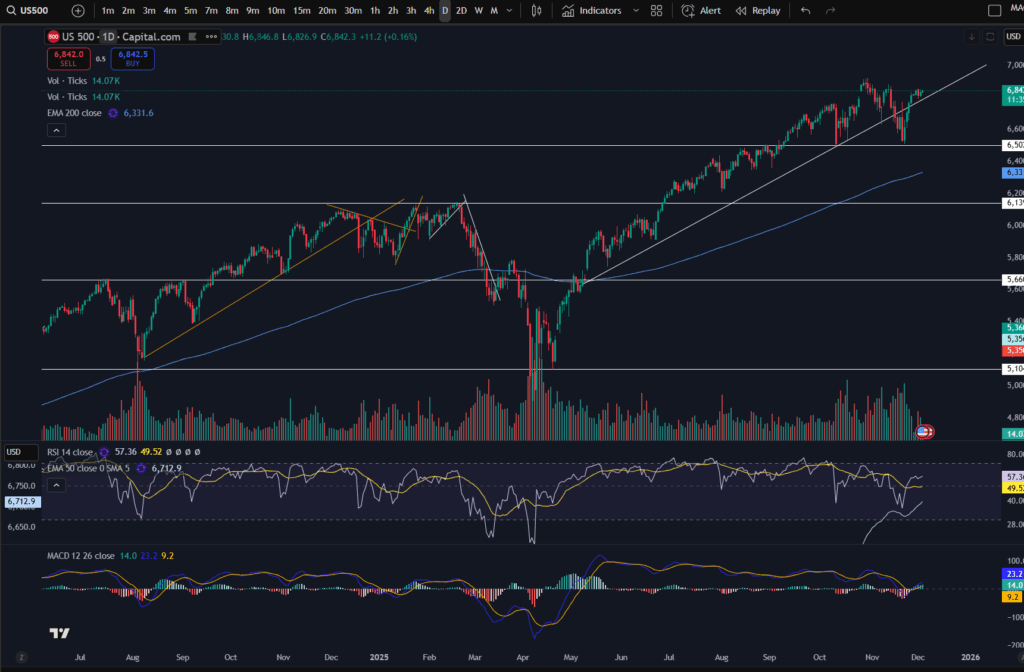
Pictured below is the chart for the S&P 500 via the Trading View application:
ETFs – Commodities
The ETF commodities track the value of an underlying commodity asset. The commodity could be crude or brent oil (priced in USD per barrel), natural gas, wheat, soy… there are many different commodities available for trading. They are typically priced at a recognised unit of measure in the relevant industry – for eg. oil priced per barrel.
ETFs – Metals
Metals can be traded too via ETFs. Some popular metals include:
- Gold (XAUUSD)
- Silver (XAGUSD)
- Copper
- Lead
- Platinum
Again, the price of these are based on typical units of measure of the underlying assets, usually in USD.
ETFs can be traded via a margin account – either a spreadbetting account, or a ‘CFD’ account (“Contract for Difference”). More on this below.
Ordinary individual stocks
You can purchase shares in a stock and own part of the relevant company. Unlike trading or investing in the ETFs, when you purchase actual stock shares, you own the underlying shares as opposed to just a contract or you making a ‘spread bet’ on the movement (more below on this). These are not purchased through a margin account but instead through a simple investment account.
When you own a stock share, you may receive dividends once or twice per year. If you purchase enough shares in the company, you will literally take control of the company.
The purchase and sale of stocks in the UK are typically subject to capital gains tax. Any dividends received will be taxed as dividend income.
Let’s look at the different types of financial instruments which can be used to open positions on these types of assets
Spread betting account
A spread betting account is used to place bets on the price movements of the underlying asset. You will never own the asset in this scenario. It is literally like making a bet a a book makers. The fee taken from the broker is heavily weighted on the ‘spread’ – the value between the buy and sell prices. The broker takes a cut by adding a bit more to the buy price for you, for example. It works in the opposite way too, when you sell.
Spread betting accounts are typically seen as ‘gambling’ and therefore exempt from personal tax liability, but note there can be some exceptions for professional traders. If you are getting to a point where you are buying and selling and making money without a day job from this method of trading, you are strongly advised to take some tax advice about the implications in the UK.
Please see my article on spread betting here for more information:
Understanding the spread – Trader Pro
CFD account (“Contract for Difference”)
Unlike a spread betting account, you will own the underlying asset in a contract for difference account. However, it is not the ‘shares’ or ‘oil’ or ‘gold’ that you will own. You will own a ‘contract’ for the price difference as it plays out in the market. If the price goes up and you purchased the asset, the ‘contract for difference’ will determine that you will be owed some money from the person on the other side of the instrument. The same is true the other way round. If you sell, thinking the price is going to go down, and it does indeed go down, the ‘buyer’ on the other side, will need to pay you, in accordance with the CFD. The broker controls the payments and receipts of all of these exchanges so this is not something for you to worry about – it is just useful for you to understand what it is, you are actually buying or selling.
CFD accounts are typically subject to capital gains tax in the UK, for individuals. (You are strongly encouraged to take your own tax advice on this).
Purchasing shares outright
In this scenario, as I mentioned above, you will own the underlying share, and you will benefit from all voting and dividend rights attached to the share. These are typically subject to capital gains tax in the UK although, as noted above, you should take your own tax advice about the implications of what you are trading, for tax purposes.
I hope you found this article helpful. I also posted a video – maybe you are more of a visual person and it would be helpful to see me talking through these instruments on a screen:
Understand my strategy in full: https://www.patreon.com/Traderpro8320
For more great tips on trading the financial markets, please visit my blog:
Discount on Trading View:
https://www.tradingview.com/?aff_id=117138
Finally, thank you to my existing members on Patreon, and for your likes, comments and subscribes. Happy trading!
Please note any subscriptions taken via my affiliate link with Trading View may result in me earning a small commission.