In this article i’m going to talk about the Gold price chart and some of the key aspects of understanding how to trade Gold. We will look at the longer term price action per the chart and its relationship with stocks and confidence in the overall economy. Let’s get straight into it!
Gold Price Chart – relationship to the stocks and general consumer confidence
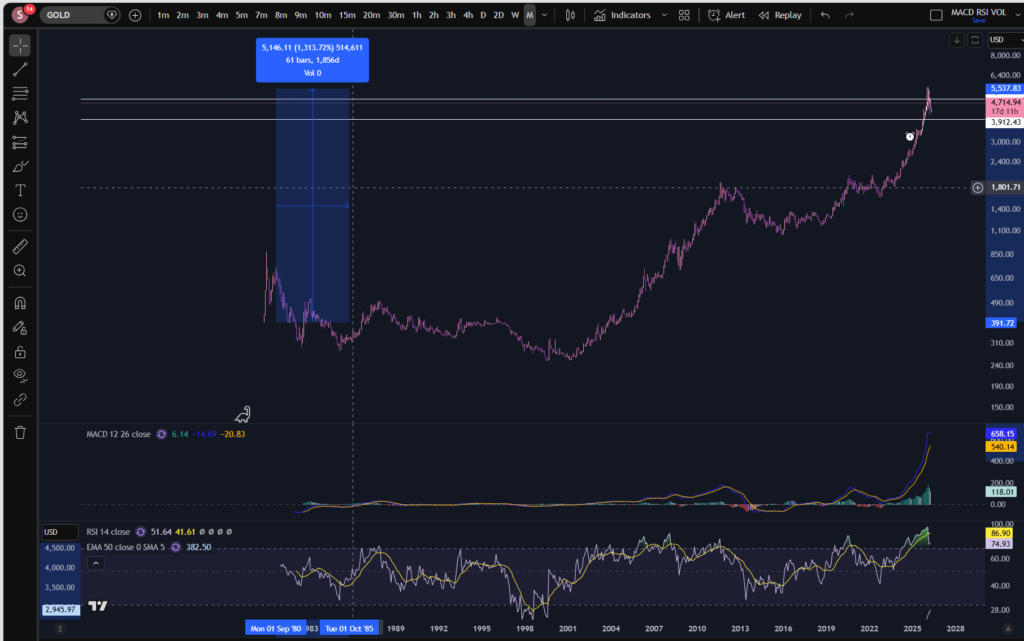
There is an inverse relationship between consumer confidence and the price of gold. This is because when consumer confidence is low, consumers consider that Gold, a precious metal which is real physical thing and valuable in the real world, is worth investing in. The value of Gold increases slowly and steadily over time, like a slow, steady, ticking clock. Let’s take a look at the monthly timeframe chart to get a view of the long term movements of Gold:
If you would like a discount to the chart software that I use (Trading View), please click the link below:
As you can see on the above chart, dating back to 1980, the price of Gold has climbed slowly to a record high. Over this time, the price increased by 1,313%.
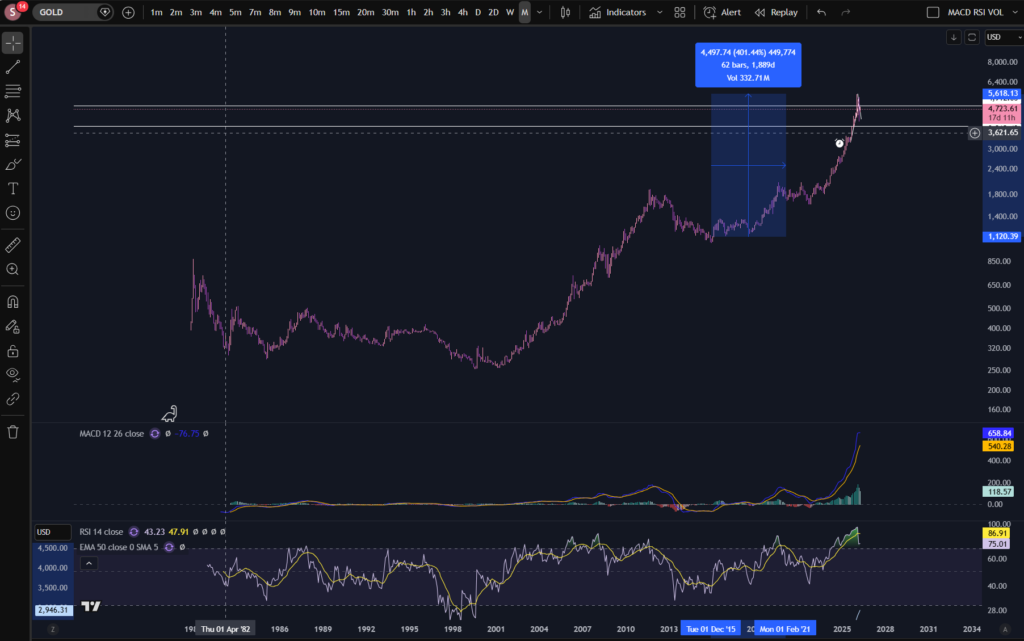
Over the last ten years, the price grew by approximately 400%:
On average, over the ten years this works out to be:
5,618-1120 = 4498 USD
/10 =449 USD per year
This works out to be an annualised return of approximately 13.7%.
When economic growth is strong, consumer confidence is high, and consumers tend to favour higher yielding investments rather than slow and steady. This can cause the price of Gold to dip.
How is the Gold price chart affected by inflation?
If consumer confidence is being driven or influenced by inflation, we may see the Gold price chart prices increasing with a corresponding decline in the relevant currency value.
So is there anything we can use to give us an indication of what levels of consumer confidence are relevant? Yes! We can use the Conference Board’s Consumer Confidence Index (CCI). You can see the website for the CCI here:
If targets are missed, this can trigger nervousness for the markets and this will likely have a positive impact on the Gold price chart.
What happens to the Gold during a recession?
The price of Gold tends to increase during recessions as consumer confidence tends to be lower. As mentioned above, when consumer confidence is low, people tend to invest their money in Gold as a saver haven until the turbulence has reduced in the stock market.
Gold Price Chart – is there anything else to be aware of?
Although the Gold price chart is typically inversely related to consumer confidence and the stock charts, the correlation is not always perfect, as other factors can be at play, including interest rates, the strength of currency and political events and news around the Globe!
What does the CII Board currently say about what they expect to see in consumer confidence?
As per the CII website, they have published graphs showing that they expect consumer confidence to fall slightly from where it is currently. You can see this graph and data here, under the ‘Present Sitaution and Expectations’ index graph:
I hope the information published here will help you in your trading journey and in particular help you to decide whether you think the price of Gold will rise, or fall, in the medium to long term.
Disclaimer!
Nothing on this blog should be taken as financial advice or encouragement for you to enter a trade. You are expected to speak to a financial adviser or carry out your own due diligence before entering any positions. Everything on this blog is made for educational purposes and to equip you with the knowledge you need to be able to make your own financial decisions.
For more great tips and advice on trading the stock market, please visit:
Please note any subscriptions taken via my affiliate link with Trading View may result in me earning a small commission. However, I provide complete transparency on me using Trading View personally – I publish my success on the financial markets via my broker reports and any profits earned were done so by using my own Trading View subscription, so I genuinely do recommend them and have been using the Trading View charts for many years.
In this article i’m going to talk about how to invest in stocks to build wealth. I will talk about the types of due diligence you can do before deciding which stocks to invest in, how long you might want to hold them for, how you can hedge your positions and keep a balanced portfolio, and the different avenues through which you can invest in stocks including as regular asset purchases or broker accounts using leverage. Let’s get straight into it!
How to invest in stocks – why invest in stocks in the first place??
Adding stocks to your asset portfolio is a great way to build wealth. They generally increase in value over time and can generate income for you via dividend distributions. Many of the wealthy people you know of, including Warren Buffett, built their wealth by investing in and and accumulating stocks. After a period of time, the stocks gain capital value and they can accumulate to an enormous amount. Most of the pensions are invested in stocks. It is generally how wealth is built. So if you have decided you want to understand how to invest in stocks, what’s the next step? Let’s take a look!
How to invest in stocks – due diligence
OK, so you have decided that you want to built wealth by investing in stocks. What sorts of due diligence should you use, to decide which stocks to invest in? There are different approaches to this. You could keep an extremely balanced portfolio by buying into an ‘index’, or a few indices!. An example of this is the S&P 500 – you can purchase a contract like a share, based on the movements of the S&P 500. If the top 500 stocks in America increase on average, you will see a gain in your trading account. You can also receive dividends from buying into these indices. If you want to remain hedged and balanced in purchasing into indices, you could buy into the indices which are present in different countries, such as the FTSE 100, in the UK, the S&P 500 in the USA, the Nikkei 225 in Japan etc.
If you want to invest in specific stocks based on careful research, you can carry out fundamental analysis based on the company’s key published information which is usually found in the company’s financial statements. If it’s a publicly traded company, you can find the financial statements online. The analysis you can do is to look at the company’s profit statement and balance sheet – to see how healthy they are. If you do not understand how to read a company’s set of financial statements, don’t worry! We have articles prepared by an ex chartered accountant (me) that will help you, below. Navigate with the link below to the Fundamental Analysis part of this blog and you will find lots of helpful articles on understanding a balance sheet, understanding a profit statement, how dividends affect a share price, and more!
I am also sharing my videos on understanding a profit statement and balance sheet, here:
Another aspect of understanding a company’s financial position, is to understand whether it is a going concern, and will be for the foreseeable future. Please see my video on things to watch out for in a set of financial statements, here:
Aside from fundamental analysis, you can also undertake technical analysis from looking at the stock charts. I offer lots of guidance on how you can carry out technical analysis on this blog, here:
Something that can really help you to understand stock charts, is by subscribing to the platform, Trading View. This platform is absolutely amazing for sorting your watchlists and organising your potential opportunities. I can offer a discount to the trading view software. Click the button below for the discount, while it lasts!
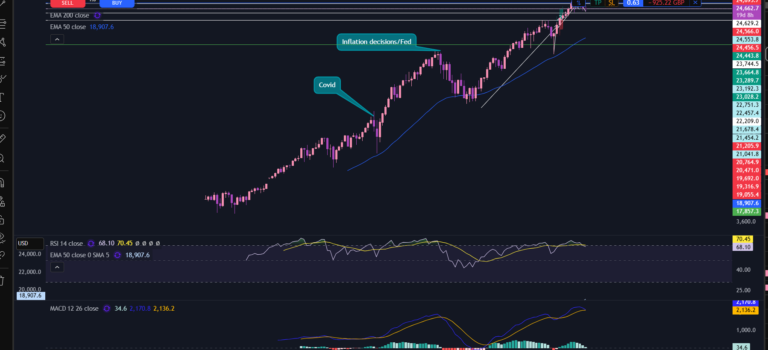
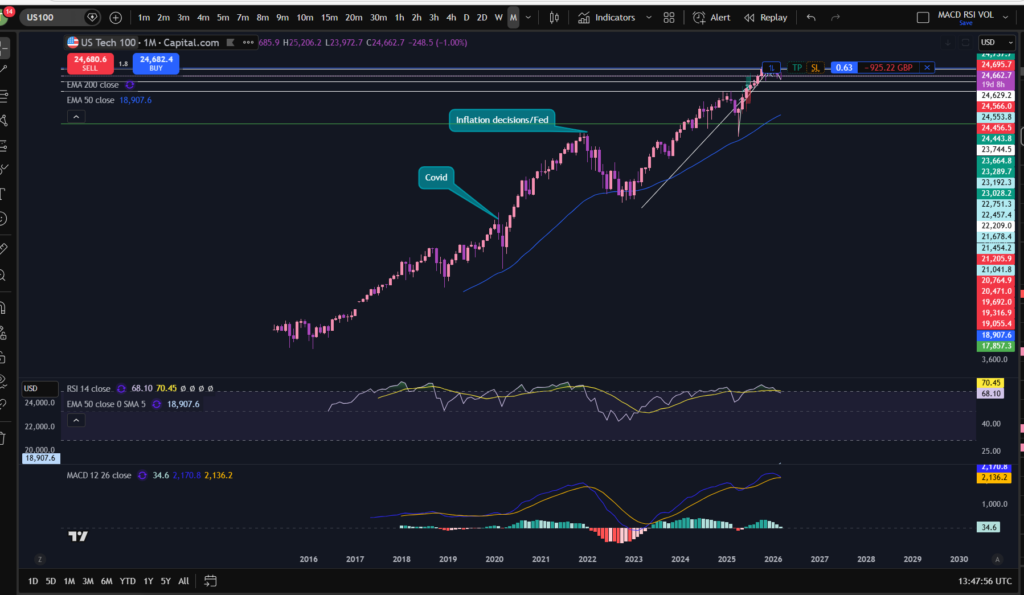
I’m showing you below a screen shot of my chart on the NASDAQ – it can be fully annotated with notes about significant events, just as one example of how versatile this chart software is!
I hope this resolved any queries you have on the due diligence aspect of ‘how to invest in stocks’.
How long should you hold stocks for?
OK, so you have decided you want to invest in stocks to generate wealth and you have researched using our tools on fundamental analysis, which stocks or indices to buy. Now you are wondering how long to hold them for. There is no set rule for this, but if you want to generate significant wealth, it is helpful to hold them for ten years or more. Please see my video on the power of compounding, here:
Holding stocks for over ten years can generate significant levels of wealth as they compound in value like a snowball. The answer to how long you should hold them depends on the level of wealth you want to generate. If you want to retire early as a millionaire, which is completely doable, you should hold them for over ten years. The younger you start, the better – ATTENTION, YOUNG READERS!
So how do you actually invest in the stocks?
You can invest in stocks either outright where you own the underlying asset, or you can buy through a CFD or spread betting account. Note the latter two types of accounts will attract fees for holding the positions overnight. There are many brokers that do not charge you for holding positions overnight such as Trading 212 (I have no affiliation with them but I do use them myself for holding long term positions without leverage).
If you hold positions in a spread betting or CFD account you are able to buy more assets than you actually have the cash for! I explain this on my margin blogs and videos, linked below. You will not own the underlying assets in these scenarios, so the dividends will be lower too:
I hope you found this article helpful on how to invest in stocks. Perhaps if you did, you can leave a comment below. I would love to hear from you, and answer any questions you might have.
In this article i’m going to talk about how to buy stocks to build wealth. I will talk about the types of due diligence you can do before deciding which stocks to purchase, how long you might want to hold them for, how you can hedge your positions and keep a balanced portfolio, and the different avenues through which you can buy stocks including as regular asset purchases or broker accounts using leverage. Let’s get straight into it!
How to buy stocks – why buy stocks in the first place??
Adding stocks to your asset portfolio is a great way to build wealth. They generally increase in value over time and can generate income for you via dividend distributions. Many of the wealthy people you know of, including Warren Buffett, built their wealth by buying and accumulating stocks. After a period of time, the stocks gain capital value and they can accumulate to an enormous amount. Most of the pensions are invested in stocks. It is generally how wealth is built. So if you have decided you want to understand how to buy stocks, what’s the next step? Let’s take a look!
How to buy stocks – due diligence
OK, so you have decided that you want to built wealth by purchasing stocks. What sorts of due diligence should you use, to decide which stocks to purchase? There are different approaches to this. You could keep an extremely balanced portfolio by buying into an ‘index’, or a few indices!. An example of this is the S&P 500 – you can purchase a contract like a share, based on the movements of the S&P 500. If the top 500 stocks in America increase on average, you will see a gain in your trading account. You can also receive dividends from buying into these indices. If you want to remain hedged and balanced in purchasing into indices, you could buy into the indices which are present in different countries, such as the FTSE 100, in the UK, the S&P 500 in the USA, the Nikkei 225 in Japan etc.
If you want to purchase specific stocks based on careful research, you can carry out fundamental analysis based on the company’s key published information which is usually found in the company’s financial statements. If it’s a publicly traded company, you can find the financial statements online. The analysis you can do is to look at the company’s profit statement and balance sheet – to see how healthy they are. If you do not understand how to read a company’s set of financial statements, don’t worry! We have articles prepared by an ex chartered accountant (me) that will help you, below. Navigate with the link below to the Fundamental Analysis part of this blog and you will find lots of helpful articles on understanding a balance sheet, understanding a profit statement, how dividends affect a share price, and more!
I am also sharing my videos on understanding a profit statement and balance sheet, here:
Another aspect of understanding a company’s financial position, is to understand whether it is a going concern, and will be for the foreseeable future. Please see my video on things to watch out for in a set of financial statements, here:
Aside from fundamental analysis, you can also undertake technical analysis from looking at the stock charts. I offer lots of guidance on how you can carry out technical analysis on this blog, here:
Something that can really help you to understand stock charts, is by subscribing to the platform, Trading View. This platform is absolutely amazing for sorting your watchlists and organising your potential opportunities. I can offer a discount to the trading view software. Click the button below for the discount, while it lasts!
I’m showing you below a screen shot of my chart on the NASDAQ – it can be fully annotated with notes about significant events, just as one example of how versatile this chart software is!
I hope this resolved any queries you have on the due diligence aspect of ‘how to buy stocks’.
How long should you hold stocks for?
OK, so you have decided you want to buy stocks to generate wealth and you have researched using our tools on fundamental analysis, which stocks or indices to buy. Now you are wondering how long to hold them for. There is no set rule for this, but if you want to generate significant wealth, it is helpful to hold them for ten years or more. Please see my video on the power of compounding, here:
Holding stocks for over ten years can generate significant levels of wealth as they compound in value like a snowball. The answer to how long you should hold them depends on the level of wealth you want to generate. If you want to retire early as a millionaire, which is completely doable, you should hold them for over ten years. The younger you start, the better – ATTENTION, YOUNG READERS!
So how do you actually buy the stocks?
You can buy stocks either outright where you own the underlying asset, or you can buy through a CFD or spread betting account. Note the latter two types of accounts will attract fees for holding the positions overnight. There are many brokers that do not charge you for holding positions overnight such as Trading 212 (I have no affiliation with them but I do use them myself for holding long term positions without leverage).
If you hold positions in a spread betting or CFD account you are able to buy more assets than you actually have the cash for! I explain this on my margin blogs and videos, linked below. You will not own the underlying assets in these scenarios, so the dividends will be lower too:
I hope you found this article helpful on how to buy stocks. Perhaps if you did, you can leave a comment below. I would love to hear from you, and answer any questions you might have.
Disclaimer!
Nothing on this blog should be taken as financial advice or encouragement for you to enter a trade. You are expected to speak to a financial adviser or carry out your own due diligence before entering any positions. Everything on this blog is made for educational purposes and to equip you with the knowledge you need to be able to make your own financial decisions.
For more great tips and advice on trading the stock market, please visit:
Please note any subscriptions taken via my affiliate link with Trading View may result in me earning a small commission. However, I provide complete transparency on me using Trading View personally – I publish my success on the financial markets via my broker reports and any profits earned were done so by using my own Trading View subscription, so I genuinely do recommend them and have been using the Trading View charts for many years.
This is a really interesting question and it’s one people can get wrong and end up wasting precious time with unless they know how to answer it for their own situation. Mostly the answer re whether you should be paying off debt or investing, comes down to the interest or earnings rates in question but there are some important other considerations, and I would like to demonstrate to you, how profound the impact of this decision can be – either in a good, or bad way!! Perhaps you want to create your dream life with supercars and a peacefulness of knowing that everything is taken care of… I hope this article will be a help in you getting there…Let’s jump straight into it…
So should you be paying off debt or investing? It’s all about the rate… – well… mostly!
Let’s say you have a loan worth £10k and the interest rate on this loan is about 6%. If you are considering paying off this loan instead of investing your money in the stock market, my suggestion is that you don’t! There are a couple of caveats which I will go into below, but on the face of it, it would not be wise to clear down the loan. I started my career as a chartered accountant and many thinks make sense to me in terms of what the numbers are saying… so let’s take a look…
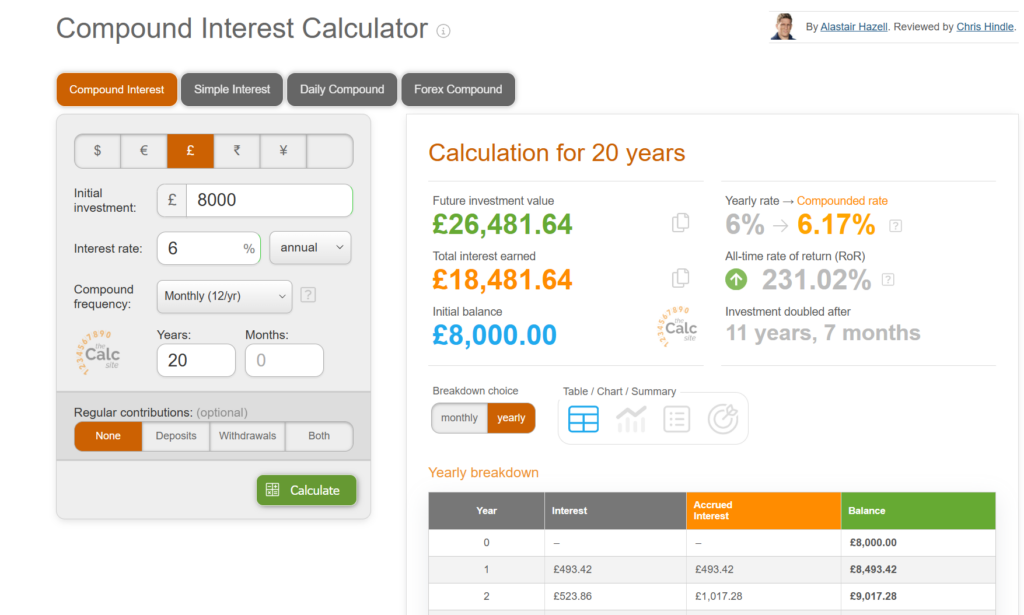
Imagine the scenario where the loan is not getting cleared in terms of capital repayment (so the worst scenario for the loan) and it’s at a rate of 6% interest. Let’s also suppose that this loan will continue to incur interest for the next 20 years. I’ve put these details into the Compound Interest Calculator – here’s a link:
I absolutely love playing around with this calculator because it’s like a crystal ball which tells me how rich I will be in the next 10 to 20 years.
OK, so we said a loan of £8k at a rate of 6% with no capital repayments. As you can see above, after a 20 year period, the amount of interest paid relative to the loan appears to be colossal… this is not insignificant in your decision about whether you should be paying off debt or investing, but I wonder whether it will look so big when we compare it to the scenario where instead of clearing down the capital of this loan, the £8k is instead, used to invest in the stock market…
Let’s run the calculator again:
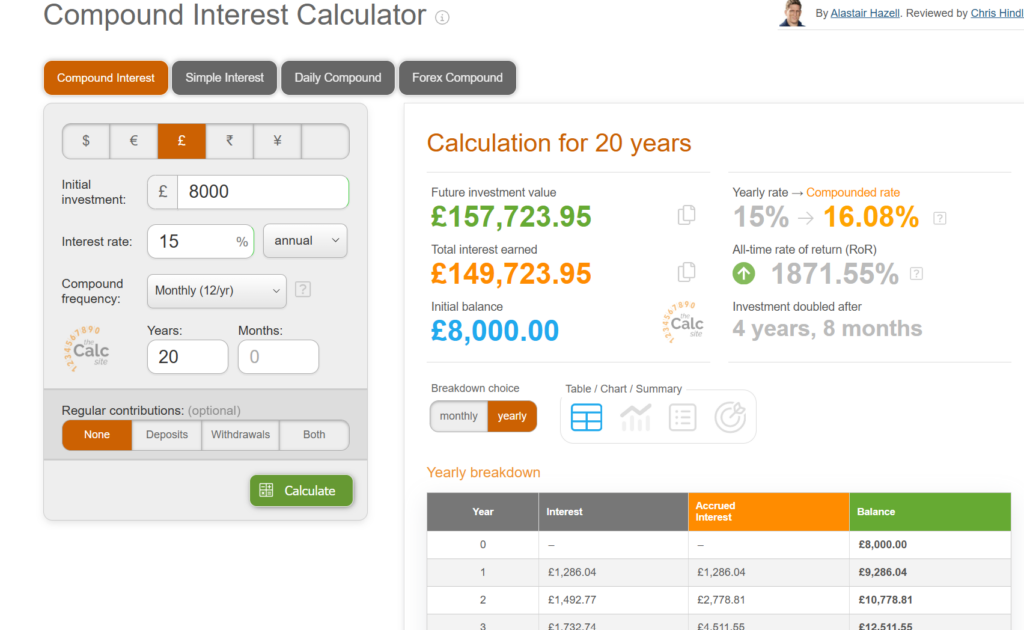
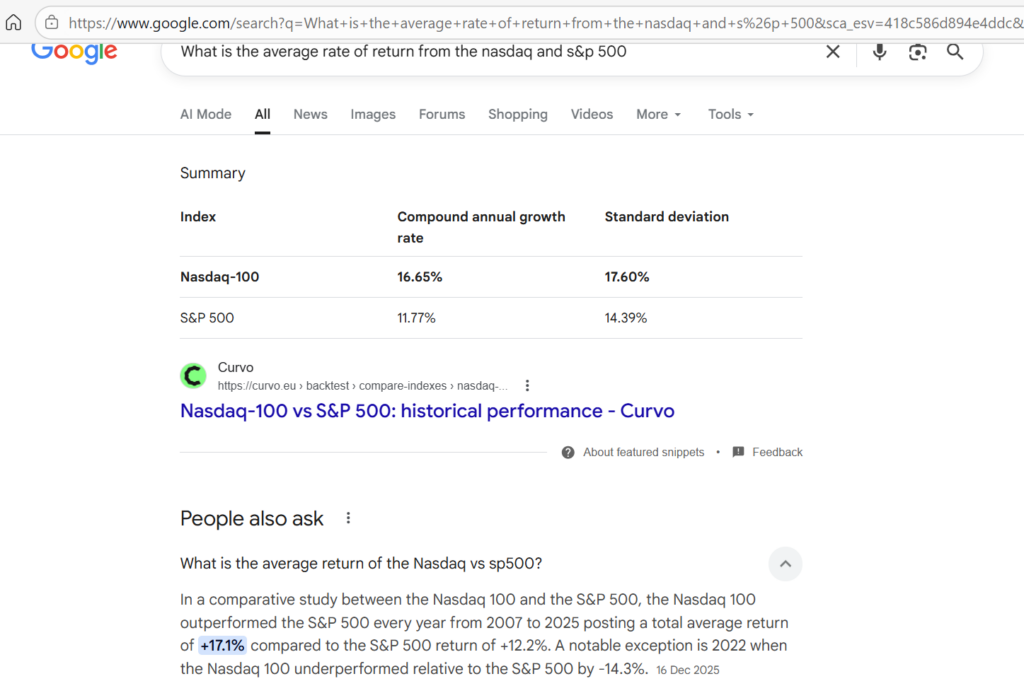
OK, so as you can see I added exactly the same details but just changed the rate. The rate of 15% is not unreasonable in terms of the rate which can be achieved on the stock market, especially when investing in something like the NASDAQ or the S&P 500 – I put the question into Google for you and this is what it answered:
So if you chose instead to invest your money in the stock market as opposed to clearing the loan, you would end up £157,723 – £26,481 = £131,242 better off. You could use some of the investment to clear the loan at that stage but even then!! My suggestion would be to let the investments earn money to ‘slowly pay off’ the loan in instalments! While it’s doing that, the investments are growing still! The answer is infinite when there is a difference in rate, in your favor! I hope this has given you some more clarity on the question of whether you should be paying off debts or investing.
Now, we must acknowledge here, that if you have high interest debts it is better to clear them – because the rate on the debt will be higher.
If you have very low interest debts they lend more weight to the idea of not clearing them and instead, investing the money.
Caveat: I am not a financial adviser – you should consult one before doing anything if you are unsure.
A caveat for you!
OK, so I said there would be a caveat and it’s this: if you are paying off debts, even where they are on a lower rate of interest and you would get a better return on the stock market, it may still be necessary to clear them a bit first – in the scenario where our outgoings are far too high and you are struggling to make ends meet. If finances are a struggle in general and the loan feels like a noose around your neck, it may be good to clear it first. However, just know, once you get to the comfortable stage, if the loan rate of interest is lower than what you can get on the stock market, you would do well to think ‘long term’ and invest the money.
Some inspiration for you- what can you achieve by investing more?
I wanted to share with you some more examples of how much your money could grow over a 10 to 20 year period, especially for someone who is young, but for older people, it’s never too late, and I did write another article on this which is linked below.
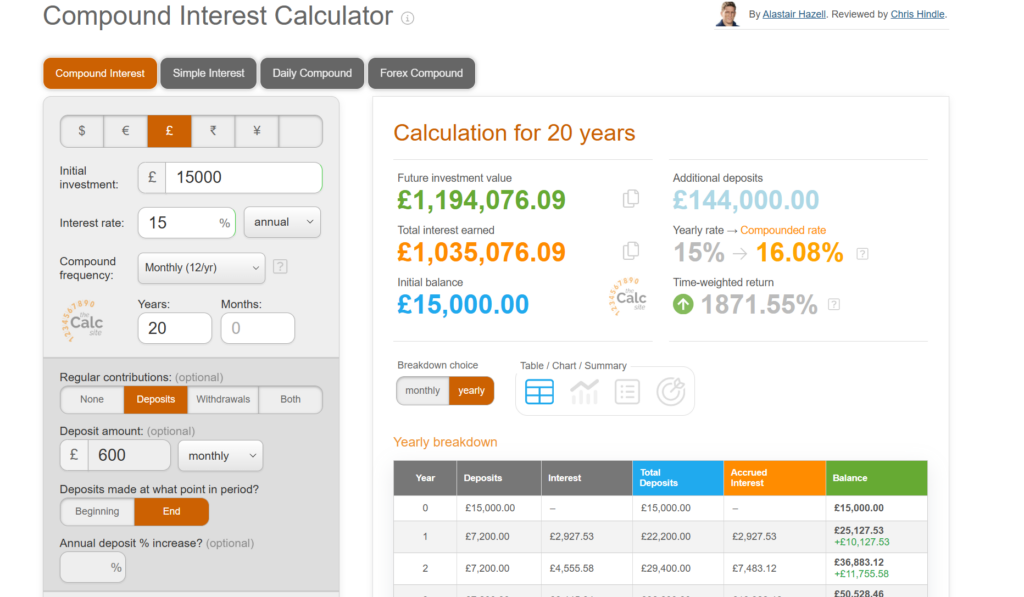
OK, so same calculation again but this time with a higher starting balance and a monthly contribution of £600. This would literally make you a millionaire after 20 years. I know £600 per month is very difficult for some families – especially in the UK but it would still be best to invest as much as you are able. Perhaps you are younger – 18? You could take slightly longer and just put money away more slowly! This is why I like to play around with the calculator.
As promised, here is the video I published about becoming a guaranteed millionaire:
Disclaimer!
Nothing on this blog should be taken as financial advice or encouragement for you to enter a trade. You are expected to speak to a financial adviser or carry out your own due diligence before entering any positions. Everything on this blog is made for educational purposes and to equip you with the knowledge you need to be able to make your own financial decisions.
For more great tips and advice on trading the stock market, please visit:
Please note any subscriptions taken via my affiliate link with Trading View may result in me earning a small commission. However, I provide complete transparency on me using Trading View personally – I publish my success on the financial markets via my broker reports and any profits earned were done so by using my own Trading View subscription, so I genuinely do recommend them and have been using the Trading View charts for many years.
Many traders and investors are asking the question ‘Are the markets going to drop in 2026?’. In this article I take a look at the current state of the markets and whether a drop could be possible and most importantly, what you can do if they do drop and in the meantime! Let’s get straight into it!
Are the markets going to drop in 2026? Where are they right now?
Currently many of the most popular and most liquid markets, are very overbought. They have reached record highs. Let’s take a look at some examples:
Are the markets going to drop? – Gold
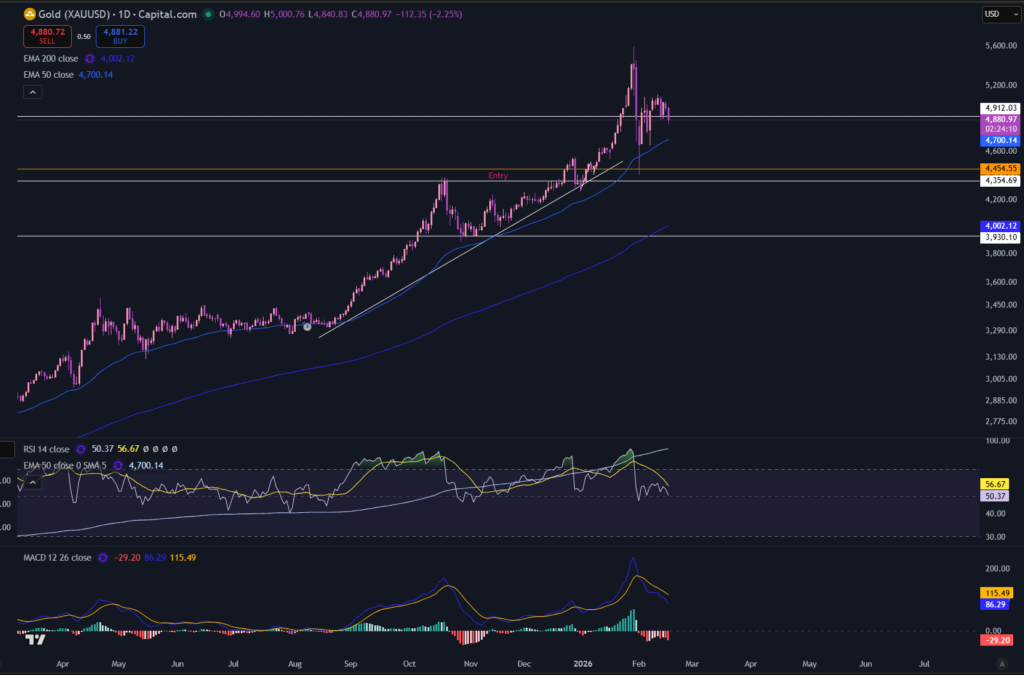
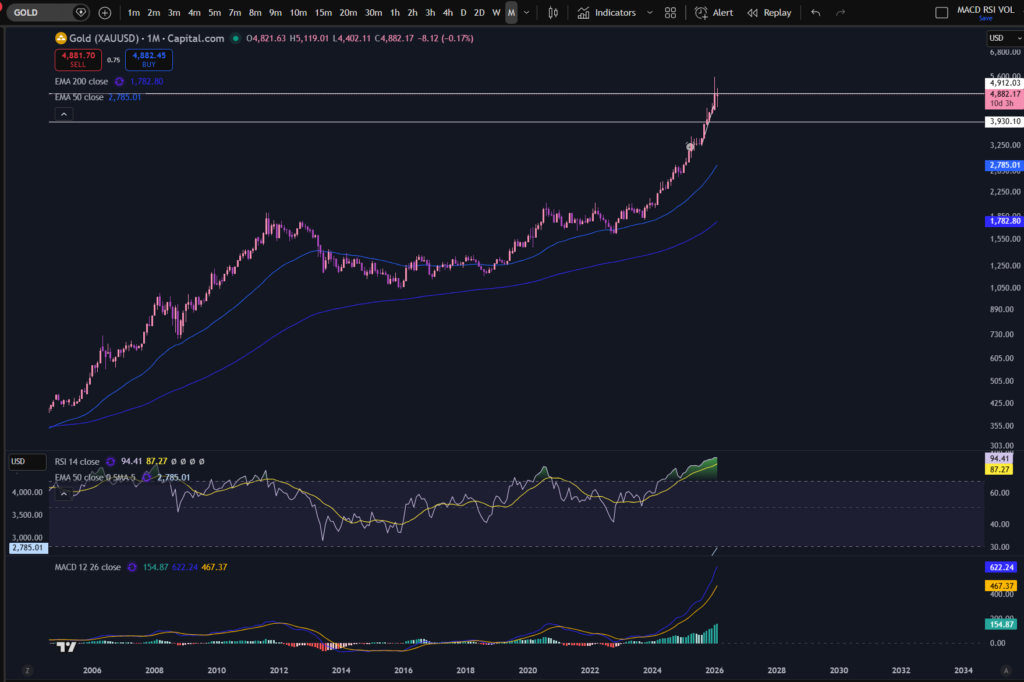
Gold has reached record highs. The chart recently reached a price of circa 5,615 USD but they took a slight downturn from this – let’s take a look at the chart to see if we can get start to answer the question, are the markets going to drop in 2026:
As you can see from the daily chart, Gold has pulled back from it’s peak. Let’s take a look at what’s going on, on the monthly chart, as this can give a better ‘birds eye’ view:
As you can see on the monthly chart, Gold has reached record highs. The RSI is currently very overextended and it wouldn’t be surprising if the market were to pull back farther than the little dip it’s made on the daily timeframe. However, nobody can predict whether the markets are going to drop – or what they are going to do. The FEDS have cut interest rates in America and this can have a positive effect on some of the markets. We are in a bit of an unprecedented situation. History tells us that when so many markets reach these types of highs, they do pull back quite a bit. It may be just a question of time!
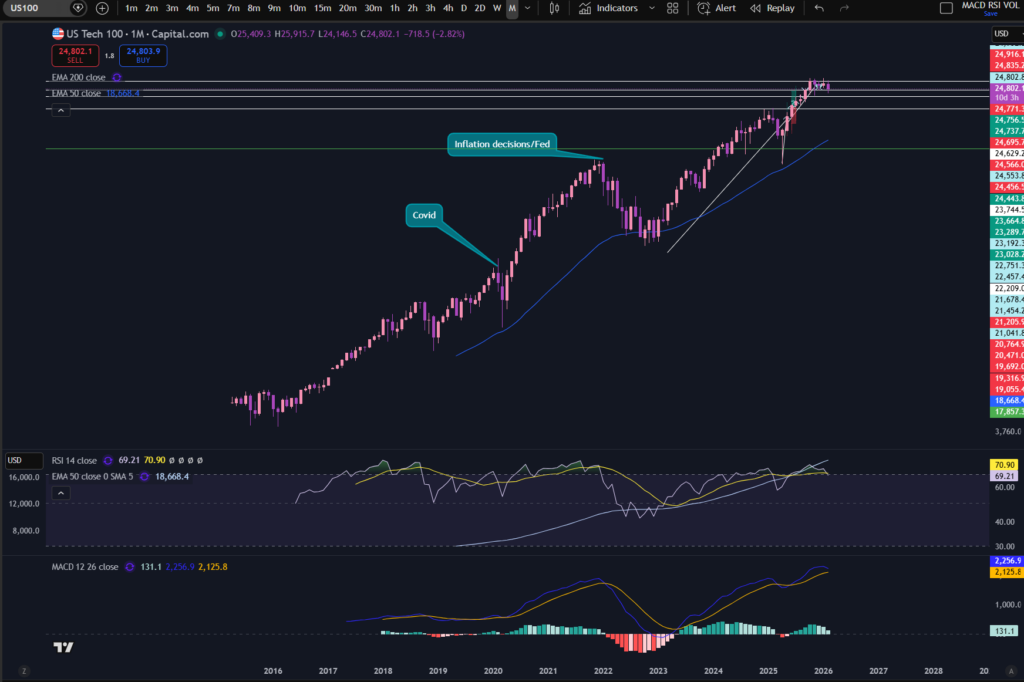
As with the case of Gold, you can see on the monthly timeframe, that the NASDAQ has sailed sky high. Take a look at the RSI and the MACD which is now bumping over to the downside! The green histogram bars on the MACD indicator are losing their pigment meaning they are losing strength currently and they are becoming smaller in size! For information I have added what happened to the markets during Covid and also the inflation struggles which have happened over the last few years and the effect of the FED’s interest rate increases on the markets.
The soaring prices on the NASDAQ have partly been inflated by expectations concerning AI and future profitability predictions surrounding this. Some people believe the AI bubble could burst. Nobody truly knows what will happen, however.
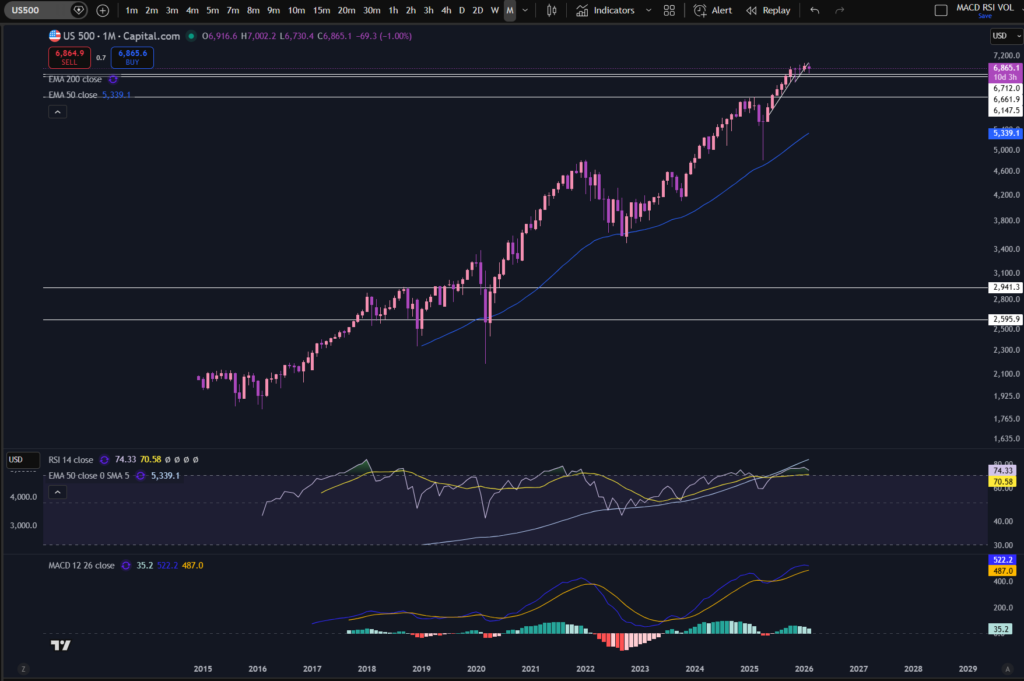
Let’s also take a look at the S&P 500 chart for good measure!
As you can see, it’s the same story on the monthly chart for the S&P 500! RSI over extended, MACD bumping over, prices at record highs.
So what to do in the scenario that the markets do ‘pull back’
Try and keep some money aside to take advantage of them on their way back up. Experienced traders and investors do not panic when the markets drop – they have dollar signs in the eyes! There is a saying that most profit is made at the time of purchase, not sale! The wealthy investors will be watching and waiting, and going shopping at the relevant time! Will you be one of them, or will you start panicking? Which one do you want to be?
It’s a good idea to do some research before the markets pull back, into which solid stocks could generate solid returns after some time. It’s a good idea to pick stocks with healthy balance sheets, in sectors which are likely to do well, and try and be diversified to hedge your risk. I posted a video on how you can carry out fundamental analysis of a balance sheet or profit statement, which you may find helpful:
Traders can manage risk in a slightly different way – there are plenty of articles on this blog about how you can manage risk. Currently, for example, I am entering small positions until the market starts moving in my favour and then I load up. This is similar to the averaging up which investors do, but I do this in trading now as well.
Conclusion – are the markets going to drop
My strong suggestion to you is to not fear the question ‘are the markets going to drop’ but rather see the this as an inevitable situation and a significant money making opportunity! Plan for the drop to happen – it will, periodically! Keep cash aside for these times to be in the best possible position, to take full advantage.
I also prepared a YouTube video on this issue which you may find helpful to watch:
Disclaimer!
Nothing on this blog should be taken as financial advice or encouragement for you to enter a trade. You are expected to speak to a financial adviser or carry out your own due diligence before entering any positions. Everything on this blog is made for educational purposes and to equip you with the knowledge you need to be able to make your own financial decisions.
For more great tips and advice on trading the stock market, please visit:
Please note any subscriptions taken via my affiliate link with Trading View may result in me earning a small commission. However, I provide complete transparency on me using Trading View personally – I publish my success on the financial markets via my broker reports and any profits earned were done so by using my own Trading View subscription, so I genuinely do recommend them and have been using the Trading View charts for many years.
Hi guys! So I want to talk to you about your corporate jobs. Maybe you are not doing a corporate job, but some other job… a job that you hate. A job you do to earn money – it’s sucking the life out of you, and you’re not sure how you can keep doing it. I want to talk to you about some things which can help you to keep going if you are in this scenario (until your escape)… If you are a woman who wants to escape the corporate hell, this article is aimed at helping you… let’s get straight into it!
Some things which can keep you going while you are waiting to escape the corporate hell as a woman…
If you are desperate to escape the corporate hell, you want to have a plan for your self – an exit plan. On this blog I help women learn to trade and invest in the stock market. If you are terrified of trading, you can be more of a passive investor rather than trader and it will still provide you with an exit plan from your corporate hell job. Investing will take a long time – I know what you are thinking! But here’s the thing… do you want to be someone who is completely free in ten years’ time, or someone who is still STUCK IN THE CORPORATE HELL in ten years time? Imagine that!
Those ten years will go by either way. You are going to get there. You will go through those ten years no matter what. At the end of those ten years, you will either be Sarah or Marylin who still works in her awful corporate job or you will be someone who took control ten years ago and freed yourself.
I’ve given advice on my youtube channel and other blog articles about how long it will take for you to become a guaranteed millionaire. Here’s a link to my youtube video on this:
You just need a plan for yourself and you need to stick to it with complete discipline. When you have that plan in your head, it helps you to keep going. The office politics and garbage which goes on in your corporate hell job, where men take credit for your work and you need to work three times as hard as them to get half of the recognition and pay….all of this garbage which goes on and consumes your energy, will no longer be relevant. You will surpass these people. In ten or twenty years time, they will just be distant memories. You will look back and laugh. So i’m guessing after listening to the above video, you now have a plan in mind about investing and your exit/escape, and at what point your exit can literally happen – a guaranteed date in the future, based on the rate at which you can invest.
Some things which can help you on your journey…
Let’s talk about the things which can help (or hinder!) you… I’ve been there, in all walks of life – I used to have a Central London job, commuting on the train every day… each morning, I would buy a latte and a croissant from Costa Coffee… in those days it used to cost about £4 or £5 per day. That was over ten or 15 years ago. These days it’s probably costing a lot more. If I told you how much this would cost over a ten year period, in lost investment opportunity, (or 20 years – even worse!), you may be very horrified… Let’s take a look:
Ten years of spending £5 per day on a coffee and snack in the morning will set you back c.£29,000 in lost investment earnings at an assumed stock market return rate of 15%. Please see the Compound Interest Calculator website, as explained in my above video!
Twenty years of spending £5 per day will cost you a whopping £162k….
Yes, you read this correctly.
One hundred and sixty two thousand pounds, over a twenty year period – on croissants and coffee.
At that point in time, if you had accumulated those funds in the stock market, the return (and therefore, yearly income) would be £162k x 15% = £25k per year, annual income.
So let’s sum that up… if you choose to put your £5 per day into an investment account and keep doing it for 20 years, you will have achieved a capital balance which would be enough to live on in some countries – example, it can cost 1,000 euros per month in living expenses in some of the European countries like the Greek islands, Portugal etc. Half of your annual income on your saved coffee money. You would live like a king in Thailand or somewhere similar I bet!
That could be an escape right there – without any further effort on your part! OR… You could have your coffee and snack on your way to your big corporate hellish job, every day, for the rest of your life/till you retire and always be trapped in that? Which would you prefer? This is just the coffee and croissant money – I’m expecting you might be able to spare a bit more than that, and get your £1m by the time you quit the corporate hell – then you can literally do whatever the hell you like, and live wherever you want.
Don’t forget, you can always buy a multi pack of croissants from Aldi each week and just take one with you! It doesn’t need to be complete suffering and austerity! Get yourself a lovely travel mug and take a nice coffee with you as well! This is also better for the environment so an added bonus! Obviously this lesson does not just relate to coffee – are you spending money on other things which can be avoided and the money invested instead? Lottery tickets? Newspapers? Cigarettes? Chocolate bars from the Central London shop instead of buying a muti pack from Tesco with the weekly shop? The list is endless of where you could find money to invest.
Make the corporate hell worth it…
Hear me out on this…It’s never going to be enjoyable, but overall, you want to make the hellish nightmare of a corporate job worth it in some way – for yourself. You want to be doing it, for YOU… Not your boss, not the employer, not the business. If you use the money in a smart way and built wealth and an escape route you can justify having to deal with it. It is way less justified when you spend the money on coffee and croissants and it’s causing you to be trapped in that nightmare, FOREVER.
A word on switching the corporate hell in one job, for another
So we’ve discovered we always want to have our ‘plan’ in mind while we are putting up with the corporate hell. Another issue I want to talk to you about, is ‘moving jobs’. Sometimes it’s easy to think “if I get a new job, everything will be fine” I can almost guarantee you, it won’t be. The grass will not be greener. You will get the same sorts of issues with different people and managers. All of the jobs are expecting you to work free overtime to sustain the activities of the business. It’s corruption at it’s finest. Tesco is not expected to give out free food, but for some reason, employees are expected to do free overtime and charity work for their employer…This will be the same in any job.
Here’s a reason you might want to actually move though:
Your boss is a complete narcissist and it is literally destroying you, and is becoming very toxic emotionally for you – it’s way beyond normal corporate hell issues;
If they are not paying you the market rate for your experience. This can happen if you are in a job for a long time, through lack of pay rise/inflationary rises. This second issue will affect your ‘plan’ because you will need to work longer to get there. So if your rate of pay is negatively affecting your plan, this would be a good reason to move.
If the issues you have in work are the bog standard, free overtime required, your boss is annoying, you have men trying to undermine you as a woman in the work place, my suggestion is you just stay there and invest more heavily and in the back of your mind, laugh at them. Laugh at the fact that you are on your way out, literally, and Derek and Bryan will still be d*ck measuring for a measly 3p per hour promotion in the office, when you are long gone.
So, to sum up, if you want to escape the corporate hell, you need to TAKE CONTROL. Make a wealth building journey ‘plan’. Work out exactly how much you need to invest regularly to become a millionaire. Write down the plan and commit yourself to your escape route. This is 100% doable. This is how the wealthy people became wealthy – by investing in the stock market.
You do not need a lot of knowledge to become a passive investor – you could put a set amount from your salary into one of the indices like the S&P 500 which is the average of the top 500 stocks in America and just leave it there and watch it grow!
Let’s generate wealth independently, together!
If it’s easier for you to digest this on a video, please see the video below.
For more great tips and advice on trading the stock market, please visit:
Please note any subscriptions taken via my affiliate link with Trading View may result in me earning a small commission. However, I provide complete transparency on me using Trading View personally – I publish my success on the financial markets via my broker reports and any profits earned were done so by using my own Trading View subscription, so I genuinely do recommend them and have been using the Trading View charts for many years.
Cookie Consent
We use cookies to improve your experience on our site. By using our site, you consent to cookies.
Used by Google Analytics to determine which links on a page are being clicked
30 seconds
_ga_
ID used to identify users
2 years
_gid
ID used to identify users for 24 hours after last activity
24 hours
_gat
Used to monitor number of Google Analytics server requests when using Google Tag Manager
1 minute
__utmt
Used to monitor number of Google Analytics server requests
10 minutes
__utmb
Used to distinguish new sessions and visits. This cookie is set when the GA.js javascript library is loaded and there is no existing __utmb cookie. The cookie is updated every time data is sent to the Google Analytics server.
30 minutes after last activity
__utmc
Used only with old Urchin versions of Google Analytics and not with GA.js. Was used to distinguish between new sessions and visits at the end of a session.
End of session (browser)
__utmz
Contains information about the traffic source or campaign that directed user to the website. The cookie is set when the GA.js javascript is loaded and updated when data is sent to the Google Anaytics server
6 months after last activity
__utmv
Contains custom information set by the web developer via the _setCustomVar method in Google Analytics. This cookie is updated every time new data is sent to the Google Analytics server.
2 years after last activity
__utmx
Used to determine whether a user is included in an A / B or Multivariate test.
18 months
_gac_
Contains information related to marketing campaigns of the user. These are shared with Google AdWords / Google Ads when the Google Ads and Google Analytics accounts are linked together.
90 days
__utma
ID used to identify users and sessions
2 years after last activity
Marketing cookies are used to follow visitors to websites. The intention is to show ads that are relevant and engaging to the individual user.
A video-sharing platform for users to upload, view, and share videos across various genres and topics.
This cookie is used to play YouTube videos embedded on the website.
2 years
VISITOR_PRIVACY_METADATA
Youtube visitor privacy metadata cookie
180 days
GPS
Registers a unique ID on mobile devices to enable tracking based on geographical GPS location.
1 day
VISITOR_INFO1_LIVE
Tries to estimate the users' bandwidth on pages with integrated YouTube videos. Also used for marketing
179 days
PREF
This cookie stores your preferences and other information, in particular preferred language, how many search results you wish to be shown on your page, and whether or not you wish to have Google’s SafeSearch filter turned on.
10 years from set/ update
YSC
Registers a unique ID to keep statistics of what videos from YouTube the user has seen.
Session
DEVICE_INFO
Used to detect if the visitor has accepted the marketing category in the cookie banner. This cookie is necessary for GDPR-compliance of the website.