What is leverage in trading?  Everything you need to know!

What is leverage in trading? Everything you need to know!

In this article i’m going to answer the question, ‘what is leverage in trading?’. The answer to this question is something you absolutely must become familiar with if you are to become successful as a stock market trader. I will explain to you about the different types of leverage and how you can check the details so that you know exactly what you are dealing with in your broker account.

What is leverage in trading? Let’s start with the basics!

The best way I can describe leverage to you is for you to think about it as a loan for a large portion of a pie. Imagine that the asset you want to purchase, is divided up into pie pieces:

In a broker account with leverage, the broker will ask you to put down, as a deposit, maybe, one slice of pie – this is known as the margin. Why ‘margin’? Think of the margin as a small portion of a page – like the margin on a page. The rest of the pie will be funded by a loan (leverage). What is the point of this? It means when you use a leverage account, you can get into larger position sizes (purchase larger assets) than you would otherwise have been able to afford with your cash in the account.

To fully understand the answer to the question, ‘What is leverage’, you must also understand how much leverage is given by the broker

The amount of leverage (the proportions of the pie funded by a loan vs your own cash), will depend on the type of asset in question, and the broker account. I have set out the typical scenarios below:

Equities

Typically, equities (shares) attract leverage of 4/5 meaning 4 portions of the pie will be funded by the broker as a loan, and 1 portion of the pie will be funded by your cash. (1:5 ratio/20%).

Commodities

Commodities, such as oil, gas, coffee, orange juice etc, will typically attract leverage of 9/10ths of the position size, meaning you put down 10% as your cash deposit, and the broker funds the other 90%.

Indices

On indices you can obtain the most leverage. These instruments can typically allow you to borrow 19/20ths of the asset value with leverage and 1/20th will be funded by your cash.

How can you tell or check what the leverage is, on an asset, before you trade it? If you click on the asset ‘details’ within your broker account, it will say something like 20:1 (for an index) or 5:1 for an equity. Meaning, for every 1 you put in yourself on an equity trade, the broker will fund the other ‘4’.

What are the benefits and drawbacks of using leverage?

The basic benefit is that you can open larger positions so if you are a profitable trader you will make more profit. The downside is that the broker will charge you fees, like interest, for taking the loan in the form of leverage. These are seen in your account as overnight funding adjustments. The broker often charges you if you hold the leveraged positions overnight.

What is leverage in trading: How the leverage is managed in a broker account

On entry into a buy position, the broker will check that you have enough money to cover your deposit (margin). This deposit money will be ring fenced while you are in the trade. The broker typically shows you the amount of margin being used on open positions, and the amount of buying power you have (which is equal to the cash in the account, plus the profit or loss on any open positions, less the margin being used). The rest of the position you purchase will be on a loan.

Important information you MUST KNOW to complete your understanding of ‘what is leverage in trading’

NOTE! – AND THIS IS VERY IMPORTANT! Before you complete your understanding of what is leverage in trading, you must know this. The amount of loss you can take, when trading with a margin/leverage account, can be more than the cash in your account. HOW? I will explain below with an extreme scenario so you get the point.

Imagine you enter a position where the price of the asset is £5,000 for one share, and it’s a share/equity.

ENTRY: £5000 X 2 portions = £10,000 value of trade.

Margin/deposit required: £2,000 – the instrument is an equity so as above, 1/5th of the value of the trade is set aside for margin/deposit.

Cash in account at entry: £2,100.

Price movement: The price goes against you, and each share is now worth £1,000.

Now your open position is worth £2,000. £1,000 x two shares = £2,000.

You have lost on the trade, £10,000 (value at entry) – £2,000 (current value) = £8,000 LOSS.

Your cash level at entry, was only £2,100 – so you have now lost more money than the level of cash you had in the account at the outset.

This is why trading with margin is very dangerous unless you know and fully understand how it works. Don’t worry – this article will help you!

The reality is that you would have got a ‘margin call’, from the broker, asking you to fund the account at the point where you are going into a position where you do not have enough funds to cover the margin. (The broker will deduct/ringfence your loss from the available funds so in the scenario above, the cash in the account was depleted by the loss on the trade). You see, while the position is open, the margin and leverage is moving around, in accordance with the latest share price, compared to your entry point.

If you find it easier to hear and see a video on this, I also published a video on my YouTube channel, here:

I hope you found this article helpful, in understanding the answer to the question, what is leverage in trading. Perhaps if you did, you can leave a comment below?

Disclaimer!

Nothing on this blog should be taken as financial advice or encouragement for you to enter a trade.  You are expected to speak to a financial adviser or carry out your own due diligence before entering any positions.  Everything on this blog is made for educational purposes and to equip you with the knowledge you need to be able to make your own financial decisions.

For more great tips and advice on trading the stock market, please visit:

https://sophiatrades.co.uk

To watch me trade live please visit my patreon page here:

https://www.patreon.com/Traderpro8320

Finally, if you would like to receive a discount on the Trading View charting software I use, please click on the relevant link here:

https://www.tradingview.com/?aff_id=117138

Please note any subscriptions taken via my affiliate link with Trading View may result in me earning a small commission.  However, I provide complete transparency on me using Trading View personally – I publish my success on the financial markets via my broker reports and any profits earned were done so by using my own Trading View subscription,  so I genuinely do recommend them and have been using the Trading View charts for many years.

What is trading?  Everything you need to know…

What is trading? Everything you need to know…

I want to help beginner traders understand and answer the question, ‘what is trading’. I’m going to explain what trading is in this article, the difference between trading and investing, what types of returns you should expect from trading and how you can get started. Let’s get straight into it.

What is trading? Some basics…

Trading is the buying and selling of equities (shares), commodities, metals, contracts or other types of assets on an exchange. For every buyer, there is a corresponding seller and these buy and sell actions, drive the price and volume in any market. The idea with trading, is that you buy and sell at favorable points on a chart (or based on fundamental data), and the buy and sell happens more quickly typically, when compared to what an investor does. An investor typically buys assets over and over and holds them until they increase in value by a large amount, over a long period of time. Traders can be day traders – people who get in and out of trades within one day, or swing traders – where trades can span over the course of a couple of days or more. I’ve provided a link below to help you understand ‘fundamentals’. Fundamental analysis is the method of inspecting financial statements to try and ascertain the value of a share with a view to buying it low and selling it high!

Fundamental Analysis – Trader Pro – Learn how to Trade the Stock Market

I am also providing you with a link to a structured course which can help you understand how traders decide where to buy or sell based on ‘technical analysis’. Technical analysis is purely based on the patterns forming on a chart (which stem from events and real world scenarios – the patterns can form based on what real people think a share is worth for example):

Learn to trade – Trader Pro – Learn how to Trade the Stock Market

See also the chart analysis section of this blog, here, where you can see me doing this analysis and explaining my thoughts:

Chart analysis – Trader Pro – Learn how to Trade the Stock Market

What types of returns can you make from trading the stock market?

Traders can make 100% return on their capital, in a year. The reality is that different traders make different amounts – but if you are trading, rather than investing, you definitely want to be making more than a regular investment return. You are taking more risk than what you take with investing money in a more straight forward way as an investor, so risk normally goes hand in hand with return (or it should).

So how do these transactions take place?

We cannot answer the question ‘what is trading’ without considering how these transactions come about. Most transactions take place online these days. You can open a broker account to either buy shares and own the shares or you can open a position based on the movement in the price and enter into a ‘contract for difference’. This is where you enter into a contract with the other party, to agree that if the price goes the way you think it will, the other party will pay you xzy amount of money and vice versa. If the price goes against you, you will need to pay them. The other way of trading is via a ‘spread betting’ account. This is like placing a bet on the price movements of the underlying asset and for most intents and purposes, it is treated and seen, as gambling. There are different tax implications for these three different methods of trading, and broker accounts can be opened online to go with any method you believe is right for you.

What else do you need to know when understanding the answer to the question, ‘what is trading’

Some of the types of broker accounts which can be opened (contracts for difference (“CFD”) accounts, and spread betting accounts) include leverage. Leverage is a loan which is offered by the broker to allow you to get into a larger position size than you may otherwise have been able to do. You put a deposit down on the open position, and these accounts are dangerous for a new trader because you can lose more than you put into your account! You should not trade with a margin/leverage account until you have a good understanding of this and how leverage and margin work. There are other articles on this blog explaining how you can manage your risk as a trader, which you may find helpful, as well as explaining margin and leverage:

Risk Management – Trader Pro – Learn how to Trade the Stock Market

I also published a video on YouTube which you may find helpful, on understanding how you can manage risk as a stock market trader:

I’ve also posted a video on YouTube explaining what margin is:

This introductory video on understanding the stock market, may be helpful for people who are new to the markets:

So now you understand the answer to the question, ‘what is trading’, how can you get started?

The best place to start would be by viewing my ‘Structured Course’ playlist on YouTube – which gives you some of the key lessons on how to become a stock market trader (below), and also refer to my blog article here, on how to create a trading plan:

Edit Post “How to create a Trading Plan – make big wins trading” ‹ Trader Pro – Learn how to Trade the Stock Market — WordPress

I also recommend you browse the other ‘structured course’ articles on this blog which take you through technical indicators, risk management, understanding the spread and many other things, here:

Structured course – how to trade the stock market – Trader Pro – Learn how to Trade the Stock Market – Page 3

Trader-Pro – YouTube

what is trading

I hope you found this article on ‘what is trading’ helpful. Perhaps if you did, you can leave a comment below.

Disclaimer!

Nothing on this blog should be taken as financial advice or encouragement for you to enter a trade.  You are expected to speak to a financial adviser or carry out your own due diligence before entering any positions.  Everything on this blog is made for educational purposes and to equip you with the knowledge you need to be able to make your own financial decisions.

For more great tips and advice on trading the stock market, please visit:

https://sophiatrades.co.uk

To watch me trade live please visit my patreon page here:

https://www.patreon.com/Traderpro8320

Finally, if you would like to receive a discount on the Trading View charting software I use, please click on the relevant link here:

https://www.tradingview.com/?aff_id=117138

Please note any subscriptions taken via my affiliate link with Trading View may result in me earning a small commission.  However, I provide complete transparency on me using Trading View personally – I publish my success on the financial markets via my broker reports and any profits earned were done so by using my own Trading View subscription,  so I genuinely do recommend them and have been using the Trading View charts for many years.

How to avoid pitfalls in trading with young children around

How to avoid pitfalls in trading with young children around

In this article i’m going to talk about how you can avoid pitfalls in trading with young children around you as a woman, when trading the stock market. I’m going to talk about practical tips you can apply in your trading right now, to avoid some of the things which can go wrong and cause stress. Let’s get straight into it!

First of all, let’s talk about what can go wrong in trading with young children around you

Wow – where do I begin? Here are a few examples:

Example 1 – You miss your target: you are in a trade and it’s going to go up to your target area, so you are keeping a bit of an eye on it while your toddler is eating their lunch. Sometimes trading with young children around you is unavoidable depending on the needs of the child and what’s happening with your trade set up and the market. Toddler drops lunch on the floor (along with the beaker, the rattle, the baby wipe and anything else within reach which has ended up on the floor in the preceding ten minutes). Crying ensues, stress in mommy ensues – “what am I going to feed them now – i’ve just made that lunch and it’s gone”. Trade goes near the target but mommy is focused on clearing up the spaghetti on the floor. Trade failed – it went back down to below target level and then into loss position by the time mommy realised what’s happened.

Example 2 – You forget to add a stop loss: You’re baby is asleep while you are planning and trying to execute your trade set up and entry point. You enter a buy position and just before you can set your take profit and stop loss, baby wakes up and is screaming for milk – it needs it NOW. You rush over to bubba to console them while you try and get a bottle ready and in the meantime, you have forgotten about adding your stop loss. Trade goes against you while you are heating up the baby’s milk and you end up in the red, to a level which is two times the size of the loss which would have happened, had you set your stop.

These are two examples of a multitude of things which could happen while you are keeping an eye on trades, while simultaneously looking after your baby or toddler. If you are a man or non caregiver of young children, I do not expect you to understand this. This is something which mothers contend with every day – it maybe that they are trying to do something else besides trade, quickly before their baby wakes up – there are many things which a woman could need to deal with while looking after small children, and the children are not interested in anyone else’s schedule, but their own. This is the biological reason why women ended up better at multi tasking.

OK, so we know these things can go wrong. What can you do about it as a trader to protect your account and your confidence?

The first recommendation I can make is for you to trade higher timeframes. The timeframes which should be avoided are the 5, 10, 15 minute time frames. Maybe even the 30 minute time frame. Why? The higher the timeframe you use, the more time you will have to execute your entries and exits and plan your trades. The price moves more slowly on the higher timeframe. It will give you time to sort your baby out, give him/her a bottle, adjust your target or add one automatically.

Another suggestion is to do your research at times when you know baby will be sleeping – the tasks which could have an interruption and not go wrong – like choosing which market to enter from the really high time frames like the daily, the weekly, and you can do this while your baby is sleeping in the evening but tend to him/her if he/she wakes up.

My recommendation would be to not trade without a stop loss or take profit being automatically set on your trades. You can do some analysis of what actually happened with the price movements (whether you made an error, why it went down instead of going up as you had planned etc) at a convenient time, as long as your position is automatically protected from going wrong.

I hope you found this article helpful in deciding how you can avoid pitfalls when trading with young children around you. I also published a video on my YouTube channel, on avoiding pitfalls when trading with young children- which you may find helpful:

Disclaimer!

Nothing on this blog should be taken as financial advice or encouragement for you to enter a trade.  You are expected to speak to a financial adviser or carry out your own due diligence before entering any positions.  Everything on this blog is made for educational purposes and to equip you with the knowledge you need to be able to make your own financial decisions.

For more great tips and advice on trading the stock market, please visit:

https://sophiatrades.co.uk

To watch me trade live please visit my patreon page here:

https://www.patreon.com/Traderpro8320

Finally, if you would like to receive a discount on the Trading View charting software I use, please click on the relevant link here:

https://www.tradingview.com/?aff_id=117138

Please note any subscriptions taken via my affiliate link with Trading View may result in me earning a small commission.  However, I provide complete transparency on me using Trading View personally – I publish my success on the financial markets via my broker reports and any profits earned were done so by using my own Trading View subscription,  so I genuinely do recommend them and have been using the Trading View charts for many years.

Can you make money on the NASDAQ right now?

Can you make money on the NASDAQ right now?

In this article i’m going to talk about the current and recent positions of the NASDAQ with a view to answering the question ‘can you make money on the NASDAQ right now?’. I’m going to examine the recent highs and lows and what’s happening with some of my preferred indicators. Let’s jump straight into it!

Can you make money on the NASDAQ right now – recent activity

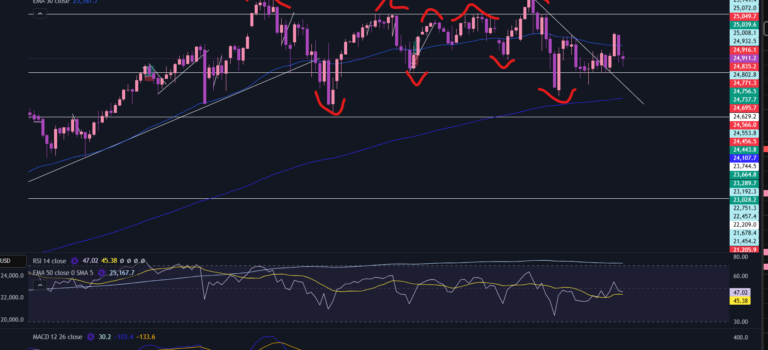
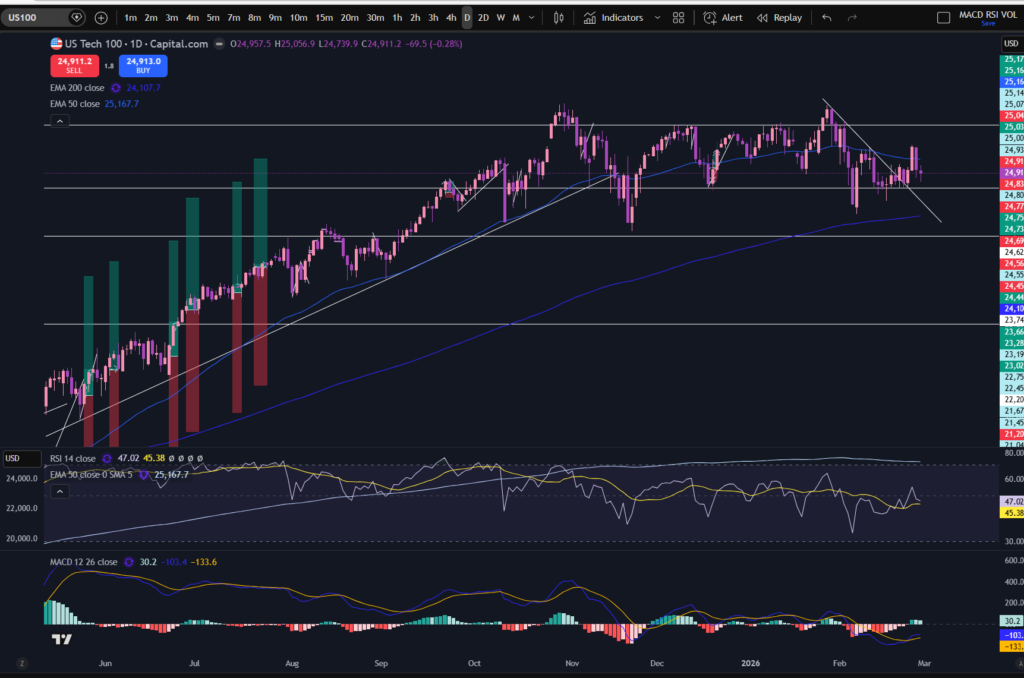
The NASDAQ is currently going sideways. It has been doing this for a long time. What does this mean? Markets can either go up, down or sideways, and sometimes they go sideways to consolidate – to allow breathing before pushing higher, or to test limits and supports before they lose strength and pull right back. You should think of a sideways market as a battery charging…. it’s building momentum to either go up, or down. When they go sideways for a long while, it can give the market a breathing space which is equivalent to the market pulling down/back – because time is passing by and the market is not reaching high prices. It allows the momentum to reset itself and you can see this on some of the indicators I like to use, like the RSI and the MACD. To help us answer the question about whether we can make money on the NASDAQ right now, let’s take a look at the daily time frame chart:

money on the nasdaq

As you can see, the market reached an all time high in mid October and since then it’s been drifting through a channel sideways. It did touch the previous high in February but since then it descended further. You can see the diagonal down trend line I had recently applied to the chart, which the price has now bust through! The price is now back at the horizontal support again and it’s bounced away from it with a hammer candlestick pattern. If you would like to understand more about candlestick patterns, please see the relevant section of my blog, below:

Japanese Candlesticks – Trader Pro – Learn how to Trade the Stock Market

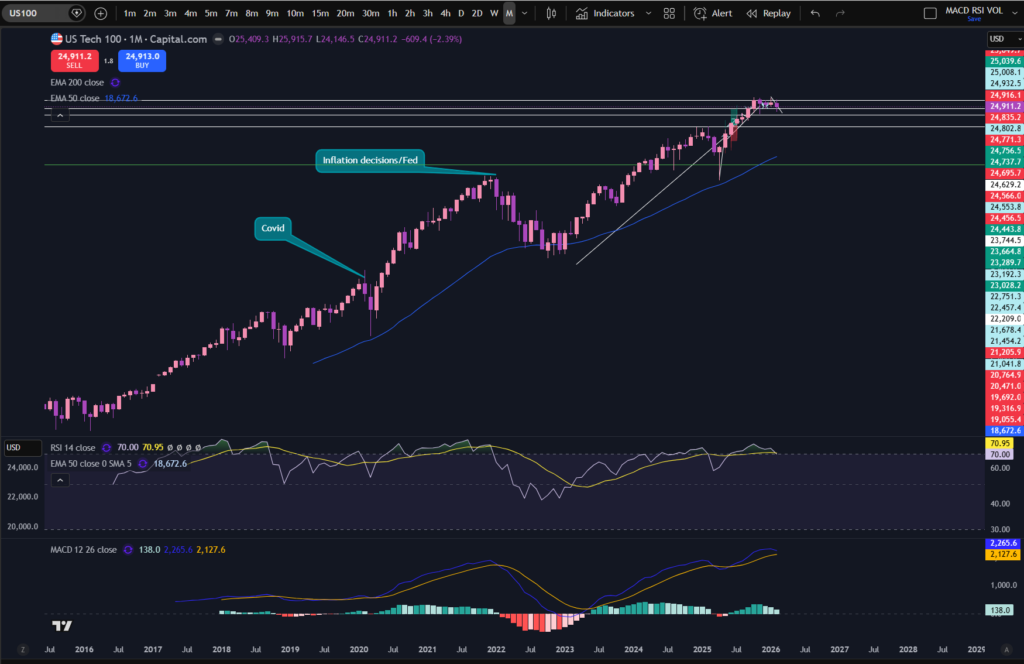
The MACD made a cross over to the upside, below the zero level of the histogram and this can be recognised as an upward push momentum but it remains to be seen how long it will last. This is the zone where the price bust through the diagonal resistance line above. In order to answer the question more fully, ‘can you make money on the NASDAQ right now’ we need to also consider the higher time frame for a birds eye view. Note: I am not in the habit of always considering the monthly timeframe – it depends. On this occasion I consider it is necessary, since the price has gone sky high recently so it may be coming to the end of a long term upwards push.

Let’s also take a look at the bigger picture – the monthly timeframe

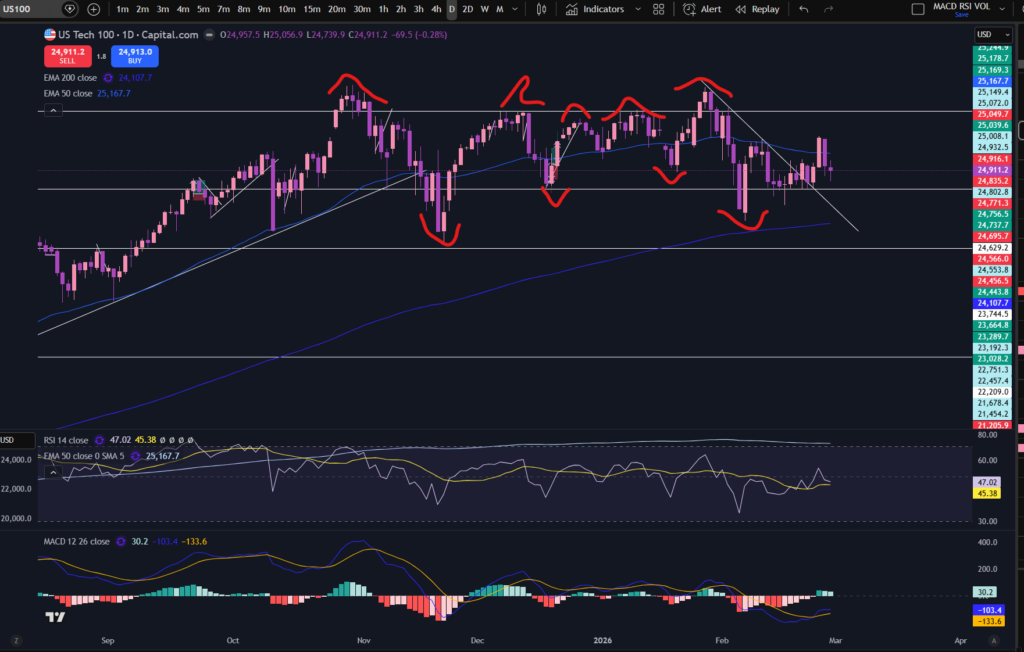
As you can see on the monthly time frame, the MACD indicator is losing momentum for upwards push – the histogram bars have gone from dark to light green and they are becoming smaller and smaller. The MACD and signal lines look like they are in a position where they could cross over to the downside. However, note that in the time the market has been going sideways, the RSI indicator has pulled back slightly meaning the price is not as expensive as it was at the peak and this is what I meant by a sideways movement allowing the price to recharge and gain energy. You can see from historical RSI movements on this chart, that the little dip which has happened recently on the RSI indicator, can sometimes be enough of a pull back for it to go up again. It is not clear what will happen next – I am simply waiting for confirmation. What do I mean by this? I’m waiting for the market to make higher highs and higher lows again. Going back to the daily timeframe, I have marked in red the recent highs and lows. At the moment the market is in a position where it is moving away from a ‘lower low’ so definitely not pushing up enough for me yet… and so I wait!

I hope you found this article helpful in answering your question, can you make money on the NASDAQ right now?

Disclaimer!

Nothing on this blog should be taken as financial advice or encouragement for you to enter a trade.  You are expected to speak to a financial adviser or carry out your own due diligence before entering any positions.  Everything on this blog is made for educational purposes and to equip you with the knowledge you need to be able to make your own financial decisions.

For more great tips and advice on trading the stock market, please visit:

https://sophiatrades.co.uk

To watch me trade live please visit my patreon page here:

https://www.patreon.com/Traderpro8320

Finally, if you would like to receive a discount on the Trading View charting software I use, please click on the relevant link here:

https://www.tradingview.com/?aff_id=117138

Please note any subscriptions taken via my affiliate link with Trading View may result in me earning a small commission.  However, I provide complete transparency on me using Trading View personally – I publish my success on the financial markets via my broker reports and any profits earned were done so by using my own Trading View subscription,  so I genuinely do recommend them and have been using the Trading View charts for many years.